|
Here's the latest Teracom newsletter!
In this issue:
- Tutorial: Low-Power Wide-Area (LPWA) Radio Networks for the Internet of Things
Learn about the four radio technologies being deployed to allow Things like shipping containers and moisture sensors to communicate for years on one battery. New lesson from Course 130.
- BOOT CAMP: Major update for the 2020s
Our famous instructor-led training has been totally updated for the 2020s, with broadband, cloud computing, data centers, 5G, IoT, broadband wireless and much more. Instructor-led in a classroom is the best kind of training you can get! Learn and retain more with a real instructor. Check it out! Download the printable detailed BOOT CAMP brochure
- Latest Schedule BOOT CAMP / Course 101 / Course 130
Get away from distractions! Chicago, San Jose, Toronto, Denver, New York, DC, Orlando, Austin, Honolulu - Waikiki Beach, and Orange County
- Online Courses: Automatic lifetime updates
Updates to CWA, CTNS, CTA, CVA and CTSME
- Special: Printed CTNS Study Guide for $49 with free shipping - save $38
- Special: CWA and CVA BUNDLE for $399 - save $419
BOOT CAMP: Major update for the 2020s

|
 |
|
BOOT CAMP has been totally updated for the 2020s with broadband Internet, cloud computing, data centers, 5G, Wi-Fi 6, 3.5 GHz broadband fixed wireless, Low Power Wide Area radio networks, a new chapter on IoT and much more. POTS was demoted from Chapter 1 to Chapter 6 to start the 2020s.
Monday – Wednesday: Course 101
The first three days of BOOT CAMP is Course 101: Broadband, Telecom, Datacom and Networking for Non-Engineers, our "core training" for non-engineering professionals, getting you up to speed on telecom, datacom and networking, from fundamentals and jargon to the latest technologies.
Part 1: The Fundamentals
- Today's broadband converged IP telecom network
- Telecom fundamentals: pulses, modems, multiplexing
- Network fundamentals: IP packets and MAC frames
- The Internet, ISPs and Net neutrality
- Web Services, Cloud Computing, Data Centers
- Residential, Business and Wholesale Services
- Digital Media: digital voice, video, images, data, text
Part 2: Telecom Technologies
- Wireless: Cellular, 4G, 5G, Mobile Internet & PSTN
- Wi-Fi, Satellite, 3.5 GHz Broadband Home Internet
- Fiber: fundamentals, WDM, Optical Ethernet, PONs
- Copper: POTS, DSL, Cable Modems, T1, LAN cables
Part 3: Equipment, Carriers and Interconnect
- Core Routers and Layer 2 Switches
- CO Switches & PBXs vs. Softswitches & Gateways
- Internet Exchanges
- Toll Centers, POPs, Switched Access, LECs, ILECs and CLECs
Part 4: Networking
- OSI Layers and Protocol Stacks
- Ethernet LANs, LAN switches and VLANs
- Routers, IP addresses, DHCP, public-private NAT, IPv6
- Carrier networks, SLAs, Class of Service
- MPLS for CoS, VPNs, integration and aggregation
- Practical solutions and project methodology
Thursday – Friday: Course 130
The last two days of BOOT CAMP is Course 130: Voice over IP, SIP, Security, 5G and IoT, vendor independent training for non-engineers covering VoIP and SIP, a comprehensive survey of security, and finishing with 5G, the Internet of Things (IoT) and examples of applications like platooning and smart cities.
Part 1: Voice over IP and SIP
- The components & operation of VoIP phone systems
- Internet VoIP telephone service
- Business VoIP systems: call managers, SIP servers, hosted PBX, cloud services, Centrex.
- What SIP is and how it works
- Voice quality: delay, jitter, packet loss
- SIP Trunking and Carrier Connections
Part 2: Security
- Security risk areas & attacker objectives
- Phishing, credential reuse and extortion
- Network security, ports and firewalls
- Public and private key encryption, digital signatures
- Digital certificates & SSL, authentication, passwords
- Wi-Fi security, Internet VPNs, VoIP security
- Viruses and trojans; zero-day exploits
Part 3: 5G and IoT
- New Radio: more bits/second and new spectrum
- 700 MHz, 800 MHz, 2.5 GHz, 3.5 GHz and mmWave
- 5G use cases; 5G handset chip: Snapdragon X55
- The Internet of Things
- Communications and computing for every Thing
- Cool applications, platooning, ultra-broadband, low-power wide-area radio networks, smart cities, IoT applications
No-one expects anyone to absorb all of this in one shot!
Included with BOOT CAMP are two printed and bound color course workbooks with detailed text notes totaling over 500 pages. Plus, registering for BOOT CAMP, you get three TCO Certification Packages: CTA, CTNS and CVA, with their 28 online courses for future reference and certification exam prep.
Some people, needing a comprehensive base in telecom, attend only the core training Course 101 the first three days, and get the CTNS Certification. Others, who already have a base, attend Course 130 the last two days for VoIP, the Security module, 5G and IoT, and get the CVA Certification.
Most people attend all five days, designated as Course 111 BOOT CAMP, to get the most comprehensive and highest quality telecommunications training available, at a discounted price, with three TCO Certifications included: CTNS, CVA and the prestigious CTA.



|
Public Schedule: BOOT CAMP / Course 101 / Course 130
Get out of the office, learn the most and retain the most with five days of the best you can get: live, in-person instructor-led training in a classroom environment, away from distractions, where you can ask questions and interact with classmates.
Chicago IL February 24-28
San Jose CA March 23-27
Toronto April 6-10
Denver CO April 20-24
New York City NY May 11-15
Washington DC June 1-5
Orlando FL June 15-19
Austin TX July 20-24
Honolulu HI September 14-18
Orange County CA October 5-9
Online Courses: Automatic Lifetime Updates
 |
|
How are online courses and certifications kept up to date?
They're based on the instructor-led BOOT CAMP courses.
When BOOT CAMP courses are updated, new lessons end up being added to the online courses, like a ripple effect. As BOOT CAMP just had a major update for 2020, new online lessons are on their way.
Anyone purchasing certification packages or courses will automatically get the updates as they are released. First up is the new lesson on 5G for CWA being added in March.
Purchase with confidence:
- Lifetime access - unlimited repeats, no time limits
- Lifetime automatic updates on new technologies
- 30-day money-back guarantee
|

Special: CWA and CVA BUNDLE for $399 - save $419
Special: CTNS Study Guide $49 with free shipping - save $38
 |
|
Profit from our misfortune! An ordering error caused us to end up with way too many CTNS study guides in stock.
At $49 including UPS shipping and no tax, take advantage of this offer to save $38 while it lasts!
Telecom, Datacom and Networking for Non-Engineers is the Certification Study Guide for the TCO Certified Telecommunications Network Specialist (CTNS) telecommunications certification, covering all material required for the CTNS Certification Exam.
Order online and apply coupon 1317.
Offer expires 2020 02 14. Valid in USA and Canada only. Free UPS ground shipping.
|
Tutorial: Low-Power Wide-Area (LPWA) Radio Networks for the Internet of Things
 |
|
Low-Power Wide-Area (LPWA) systems, also called Low-Power Wide-Area Networks (LPWANs) are wireless systems for sensor data reporting and remote control.
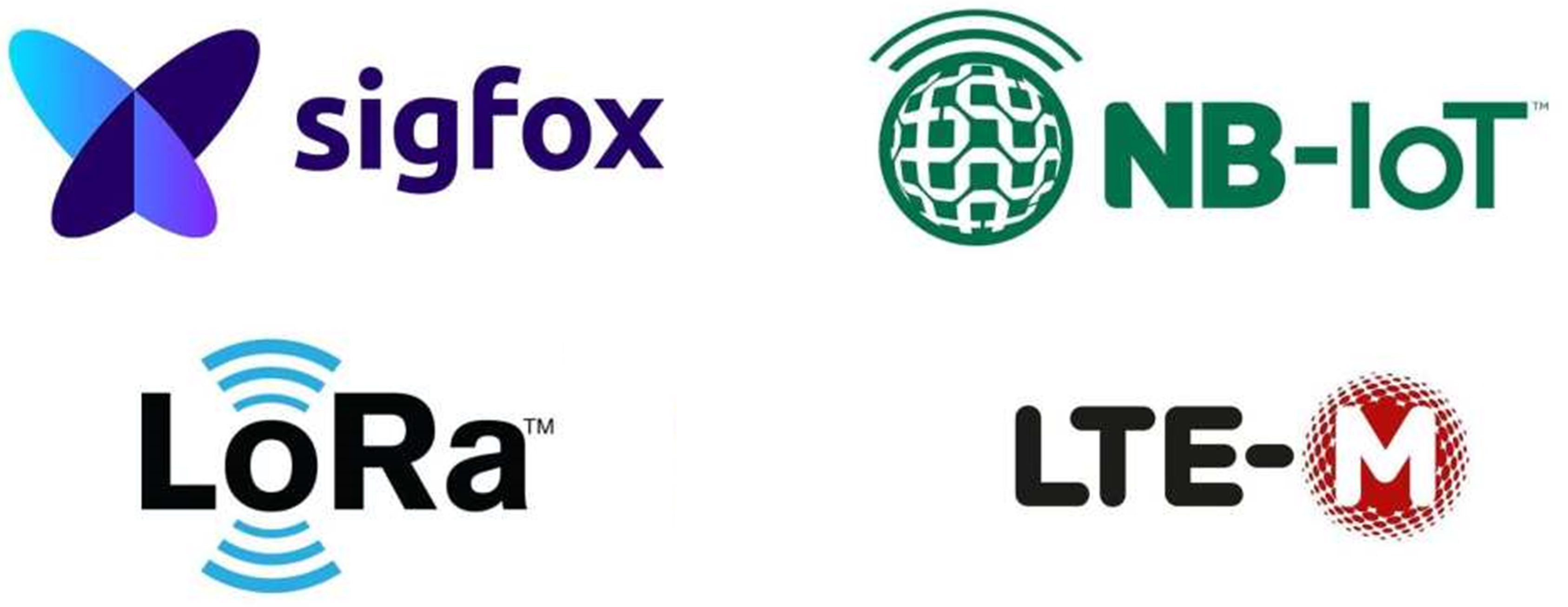
There are four main technologies, divided into two groups: technologies deployed by mobile (cellular) carriers, and technologies deployed by non-cellular carriers.
The technologies deployed by cellular operators are Narrowband Internet of Things (NB-IoT) and Long Term Evolution category M1 (LTE-M).
The technologies deployed by non-cellular operators are sigfox and LoRa (short for Long Range).
Sigfox and LoRa operate in unlicensed spectrum often called Industrial, Scientific and Medical (ISM) bands, at relatively low frequencies. In Europe the 868-MHz band is used; in the US it is 915 MHz; and 923 or 433 MHz in Asia.
Sigfox is a French company that established a base of customers with water meters from the French water authority Veolia and has expanded internationally.
It provides the leanest communication service, using 100 Hz of bandwidth to move tiny data packets with payloads of 12 bytes upload and 8 bytes download, with limits on the number of messages per day. The theoretical data rate is 600 bits per second. This reduces the subscription costs and extends battery life. It can support 1 million devices per base station transceiver.
LoRa is a competing technology also using ISM bands, using 125 kHz of bandwidth to achieve a theoretical 50 kb/s and 40,000 devices per base station. LoRa employs spread-spectrum coding, meaning the modem signal is spread over a wider frequency band than normal. This allows better performance in the presence of noise or jamming. The LoRa Alliance was created to foster interoperability between devices.
Cellular carriers offer NB-IoT and LTE-M wireless services in licensed frequency bands.
NB-IoT operates on 200 kHz channels, often in the "guard bands", i.e. unused spectrum between bands used for conventional cellular, supporting around 200 kb/s data rates depending on carrier implementation.
It is designed for fixed, ultra-narrow-bandwidth IoT applications. It purports to provide better connectivity in subterranean locations such as basements, utility vaults and sensors located deep within buildings. It does not support mobility, i.e. maintaining connection as the sensor moves out of range of a base station.
LTE-M operates on approximately 1 MHz bands on licensed spectrum, supporting up to 1 Mb/s data rates (depending on carrier implementation), as well as voice and mobility.
As the name would suggest, it is intended for existing LTE cellular networks, to provide extended coverage to IoT applications.
Due to its lower latency and higher bandwidth than NB-IoT, LTE-M is suited for IoT applications where devices are in motion and real-time data is required.
The sigfox and LoRa systems gained an early market share. Carrier NB-IoT and LTE-M systems are expected to significantly outpace sigfox and LoRa in terms of connected devices going forward.
|
Source: Course 130 Voice over IP, SIP, 5G, Security and IoT, pages 9.16 and 9.17
Your colleagues may be interested... would you please forward this to them?
Many thanks,
Eric Coll, Director
Teracom Training Institute
Here are some links that you may find useful:
| Online Courses and Certifications |
|
|
|
Privacy policy: We will NEVER give your email address or any other personally-identifying information about you to anyone without your consent. full statement
About this email: Teracom Training Institute is sending you this message following your request to receive information.
Unsubscribe:
If you have received this message in error, and/or no longer wish to receive these messages, please accept our apologies for the inconvenience, and follow these instructions to unsubscribe: Reply to this email with the word "remove" in the subject. The quote marks are not necessary.
Or sign in to your myTeracom account with username = the email address this email was sent to and
click the link for Newsletter under Account settings.
Subscribe: To receive future issues of the Teracom Training Institute newsletter, be informed of new tutorials, new lessons and courses, seminars and Teracom specials, add yourself to our private mailing list. We'll never give your e-mail address to anyone without your consent. You can unsubscribe at any time.
Copyright © Teracom Training Institute. All rights reserved.
privacy policy
contact us
FAQs, help and policies
Teracom Training Institute • 4625 W Nevso Drive Suite 2, Las Vegas NV 89103 • 1-877-412-2700
www.teracomtraining.com
|