


$119
Introduction to Broadband Converged IP Telecom is the first course in the CTNS Certification Package, providing a comprehensive introduction to broadband converged IP telecom.
Specifically designed for non-engineering professionals, this course is a first pass through the topics, explaining the fundamental ideas, jargon, equipment and technologies, the services that are sold, the players, where the money is, and how it all fits together.
Course Lessons
1. Course Introduction
2. Convergence
3. Broadband
4. Model of Today's Converged Telecom Network
5. The Network Core
6. Network Protocols: Ethernet, IP and MPLS
7. Network Access: The Last Mile
8. Anatomy of a Service
9. Services: Residential, Business and Wholesale
10. Network Equipment
11. Carrier Network Interconnect
Based on the first chapter of Teracom's famous BOOT CAMP, getting the week of training started with a comprehensive introduction to all of the different aspects of the modern converged IP telecom network. Totally up to date. Produced April 2021.
This course is the first course in the CTNS Certification Package. Purchase this item to get the individual course.
Course page with full description
The Unlimited Plan gives you unlimited repeats, with no expiration and no monthly fees. One-time payment. Take as long as you like. Jump in and out of lessons, refresh your knowledge in the future.
A course completion certificate is awarded upon passing the course exam.
Teracom is the leader in telecommunications training. In business since 1992, we supply this training to the US government under our GSA schedule contract, which means pre-approved quality and pricing. We're so confident of the quality of this training, it comes with a 30-day money-back guarantee.
$119
Wireless Telecommunications is a comprehensive course on wireless, including radio fundamentals, cellular and mobile telecommunications plus Wi-Fi and more. Fully up-to-date for the 2020s with 5G, Wi-Fi 6 (802.11ax) and Starlink.
Course Lessons
1. Introduction
2. Mobile Network Components, Jargon and Operation
3. Cellular Principles
4. PSTN Calls Using the Native Phone App: Voice Minutes
5. Mobile Internet: Data Plan
6. Spectrum-Sharing: FDMA, TDMA, CDMA, OFDM
7. 4G LTE: Mobile Broadband
8. 5G NR: Enhanced Mobile Broadband, IoT Communications
9. Wi-Fi: 802.11 Wireless LANs
10. Communication Satellites
The objective of this course is to develop a solid understanding of mobile communications networks and technologies. We'll cut through the jargon to demystify wireless, explaining the fundamentals of cellular and mobility, the buzzwords, the network, technologies and generations, the underlying ideas, and how it all works together... in plain English.
This course is the second course in the CTNS Certification Package. Purchase this item to get the individual course.
Full course description and free sample lessons
The Unlimited Plan gives you unlimited repeats, with no expiration and no monthly fees. One-time payment. Take as long as you like. Jump in and out of lessons, refresh your knowledge in the future.
A course completion certificate is awarded upon passing the course exam.
A reference book is available, in print and eBook.
You'll gain a solid understanding of the key principles of wireless and mobile networks:
• Coverage, capacity and mobility
• Why cellular radio systems are used
• Mobile network components and operation
• Registration and handoffs
• Digital radio
• Mobile Internet
• Spectrum-sharing: FDMA, TDMA, CDMA and OFDM
• Cellular technologies and generations:
- 4G LTE and OFDMA
- 5G New Radio
Plus, we'll cover the radio frequencies and standards for wireless LANs and an overview of satellite communications.
Course Outline
1. Introduction
Course overview. Basic radio principles, analog and digital
2. Mobile Network Components, Jargon and Operation
Handset, base station, airlink, handoffs, connection to wireline
3. Cellular Principles
Coverage, capacity and mobility, frequency re-use, handoffs, spectrum sharing
4. PSTN Calls Using the Native Phone App: Voice Minutes
Voice over digital radio: microphone, codec, RF modem, antenna; POP in Toll Center for PSTN connections
5. Mobile Internet: Data Plan
Using only the RF modem and antenna of the cellphone as a "tethered" modem, Wi-Fi hotspot, bluetooth; Internet Exchange for Internet connections
6. Spectrum-Sharing: FDMA, TDMA, CDMA, OFDM
A roundup of the different methods used to share radio bands amongst users
7. 4G LTE: Mobile Broadband
Subcarriers and OFDM; OFDMA for multiple access; LTE and LTE-Advanced
8. 5G New Radio: Enhanced Mobile Broadband, IoT Communications
New spectrum; millimeter-wave ultra broadband for VR; 40 percent more b/s at 2.5 GHz; low bit rates for IoT
9. Wi-Fi: 802.11 Wireless LANs
Basic principles of operation, 802.11 standards, frequency bands and limitations
10. Communication Satellites
Basic principles of operation, geosynchronous and LEO
Teracom is the leader in telecommunications training. In business since 1992, we supply this training to the US government under our GSA schedule contract, which means pre-approved quality and pricing. We're so confident of the quality of this training, it comes with a 30-day money-back guarantee.
$119
Fundamentals of Voice over IP is a complete introduction to everything Voice over IP. You'll learn the fundamental ideas and principles of a VoIP telephone system, VoIP, SIP & all the other jargon - what it actually means and how it all works together.
At each step, we'll also cover supporting and related technologies like Ethernet MAC frames and codecs and video over IP.
This course can be taken by anyone who needs to get up to speed on all things VoIP. You will gain career-enhancing knowledge of the components and operation of Voice over IP systems, and learn what all of the jargon and buzzwords mean.
Course Lessons
1. Introduction
2. VoIP Phones and Terminals
3. Voice in IP Packets
4. SIP and Softswitches - SIP Servers / Call Managers
5. Media Servers
6. Gateways
7. LANs and WANs
8. Key VoIP Standards
9. Where All of This is Headed: IP Dial Tone
Based on Teracom’s famous Course 130, tuned and refined over the course of over 20 years of instructor-led training, you will gain career- and productivity-enhancing knowledge of the structure, components and operation of voice over IP- what it is, how it works, what the main technologies are and more.
Course page with full description
The Unlimited Plan gives you unlimited repeats, with no expiration and no monthly fees. One-time payment. Take as long as you like. Jump in and out of lessons, refresh your knowledge in the future.
A course completion certificate is awarded upon passing the course exam.
Teracom is the leader in telecommunications training. In business since 1992, we supply this training to the US government under our GSA schedule contract, which means pre-approved quality and pricing. We're so confident of the quality of this training, it comes with a 30-day money-back guarantee.
$119
One cornerstone of a full, rounded base of knowledge of telecommunications is the structure and operation of the Public Switched Telephone Network, built over the past 135 years, still in operation in every country on earth - knowledge necessary for connecting the PSTN to, and steadily replacing the PSTN with IP telecom technologies.
In this course, you’ll build a solid understanding of the fundamentals of the telephone system: customer premise and Central Office, loops, trunks, remotes, circuit switching and how a telephone call is connected end-to-end. We’ll cover LECs and IXCs, sound, analog and the voiceband, twisted pair, DTMF and SS7. Updated for the 2020s.
Course Lessons
1. Introduction
2. History of Telecommunications (USA and Canada)
3. The Public Switched Telephone Network (PSTN)
4. Analog Circuits and Sound
5. The Voiceband
6. Plain Ordinary Telephone Service (POTS)
7. Signaling: Pulse Dialing and Dual Tone Multiple Frequency (DTMF)
8. Signaling System 7 (SS7)
Based on Teracom’s famous Course 101, tuned and refined over the course of 20 years of instructor-led training, we’ll cut through the jargon to demystify telephony and the telephone system, explaining the jargon and buzzwords, the underlying ideas, and how it all works together… in plain English.
Featuring many photos of actual equipment both inside a Central Office and in the outside plant, this multimedia course is an excellent way to get up to speed on traditional telephony.
This course is the first course in the CTNS Certification Package. Purchase this item to get the individual course.
Course page with full description
The Unlimited Plan gives you unlimited repeats, with no expiration and no monthly fees. One-time payment. Take as long as you like. Jump in and out of lessons, refresh your knowledge in the future.
A course completion certificate is awarded upon passing the course exam.
A reference book is available, in print and eBook.
Course Outline
1. Introduction
Course overview
2. History of Telecommunications (USA and Canada)
Local phone companies, long distance; Bell System, breakup, LECs and IXCs; Canada
3. The Public Switched Telephone Network (PSTN)
Loops and trunks, CO, customer premise, circuit-switching, outside plant, loop length, remotes
4. Analog Circuits and Sound
What analog means, microphones, speakers, copper wires and electricity, sound: trees falling in the forest
5. The Voiceband
Reproducing thoughts vs. reproducing sound, frequency range, filters, limitations
6. Plain Ordinary Telephone Service (POTS)
Twisted pair, dial tone, ringing, supervision, lightning protection
7. Signaling: Pulse Dialing and Dual Tone Multiple Frequency (DTMF)
Dial-up, make-or-break signaling, touch-tone, DTMF, in-band signaling
8. Signaling System 7 (SS7) Control system for the PSTN, call setup across competing carriers
Teracom is the leader in telecommunications training. In business since 1992, we supply this training to the US government under our GSA schedule contract, which means pre-approved quality and pricing. We're so confident of the quality of this training, it comes with a 30-day money-back guarantee.
$119
The ideas in this course allow us to relate different pieces of the puzzle together in all of the subsequent lessons and courses.
The OSI 7-Layer Reference Model is used to sort out the many functions that need to be performed, to be able to discuss separate issues separately. The functions are organized into groups called layers, which are stacked one on top of the other.
The course starts with the big picture, then one lesson for each layer, then protocol stacks.
Course Lessons
1. Introduction
2. Open Systems
3. Protocols and Standards
4. ISO OSI 7-Layer Reference Model
5. The Physical Layer
6. Data Link Layer
7. Network Layer
8. Transport Layer
9. Session Layer
10. Presentation Layer
11. Application Layer
12. Protocol Stacks
13. Protocol Headers
14. Standards Organizations
Based on Teracom’s famous Course 101, tuned and refined over the course of more than 25 years of instructor-led training. You'll learn what a layer is, what the layers are, what each one does and examples of where things like TCP fit into the model ...and how it all works together… in plain English.
This course is the third course in the CTNS Certification Package. Purchase this item to get the individual course.
Course page with full description
The Unlimited Plan gives you unlimited repeats, with no expiration and no monthly fees. One-time payment. Take as long as you like. Jump in and out of lessons, refresh your knowledge in the future.
A course completion certificate is awarded upon passing the course exam.
A reference book is available, in print and eBook.
You'll learn what a layer is, the purpose of each layer, see examples of protocols used to implement each layer, and learn how a protocol stack really works with the famous "FedEx Analogy" presented as an embedded video by our top instructor, Eric Coll.
Course Outline
1. Introduction
Course introduction and overview
2. Open Systems
Open systems vs. proprietary systems.
3. Protocols and Standards
The difference between a protocol and a standard.
4. ISO OSI 7-Layer Reference Model
Top-level overview and introduction to Layers
5. The Physical Layer
Fiber, Twisted Pair, Cable and Wireless
6. Data Link Layer
LANs and MAC Addresses
7. Network Layer
IP, MPLS, Packets and Routers
8. Transport Layer
Reliability, Connections, Ports and Sockets
9. Session Layer
SIP, POP and HTTP
10. Presentation Layer
ASCII, MIME, Compression, Encryption, Codecs
11. Application Layer
SMTP, HTML and English
12. Protocol Stacks
The FedEx Analogy
13. Protocol Headers
Babushka Dolls
14. Standards Organizations
15. Multiple-choice Exam
Teracom is the leader in telecommunications training. In business since 1992, we supply this training to the US government under our GSA schedule contract, which means pre-approved quality and pricing. We're so confident of the quality of this training, it comes with a 30-day money-back guarantee.
$119
In this course, we will understand Ethernet: the fundamentals, equipment and implementations including twisted-pair copper, wireless and fiber. You'll learn about broadcast domains, MAC Addresses and MAC Frames, Layer 2 switches, VLANs, 1000BASE-T, building wiring, 802.11 Wireless LANs, fiber and Optical Ethernet in the core, MANs and PONs.
Course Lessons
1. Introduction
2. Broadcast Domains, MAC Addresses and MAC Frames
3. LAN Switches a.k.a. Layer 2 Switches
4. VLANs
5. 802 Standards: 802.3 Twisted Pair and 802.11 Wi-Fi
6. Twisted-Pair LAN Cables, Wiring Plan and Switch Hierarchy
7. Optical Ethernet and Fiber Links
Taking this course, you'll gain a solid understanding of this essential technology:
• Broadcast domains
• MAC addresses and MAC frames
• What a LAN switch is, and what it does.
• How VLANs can be used to segregate devices into different broadcast domains.
• The 802.3 standard and communicating MAC frames at 10 Mb/s on coaxial cables to Gigabit Ethernet on copper and fiber. What the code 1000BASE-T means.
• MAC frames over the Ether, a.k.a. Wi-Fi, the 2.4 and 5 GHz unlicensed bands, and the fundamentals of how the bits in MAC frames are communicated using radio carrier frequencies.
• Wiring Ethernet to the work area with Cat 5, Cat 5e and Cat 6 twisted-pair copper-wire cables, wiring closets and Layer 2 aggregation switches.
• What Optical Ethernet is, and how it is the building block of telecom networks, including Metropolitan Area Networks (MANs), carrier MPLS networks, and Passive Optical Networks (PONs) for fiber to the home.
• The fundamentals of how the bits in MAC frames are communicated using light guided in glass tubes. How fiber cables are deployed and connected to equipment at each end. What designations like 100GBASE-ER4 mean.
Based on Teracom’s famous Course 101, tuned and refined over the course of more than 25 years of instructor-led training and counting. We’ll cut through the jargon to demystify Ethernet, MAC addresses, LANs and VLANs, explaining the jargon and buzzwords, the underlying ideas, and how it all works together… in plain English.
This course is included in the CIPTS, CTNS, CTA and CTSME Certification Packages. Purchase this item to get the individual course.
Course page with full description
The Unlimited Plan gives you unlimited repeats, with no expiration and no monthly fees. One-time payment. Take as long as you like. Jump in and out of lessons, refresh your knowledge in the future.
A course completion certificate is awarded upon passing the course exam.
A reference book is available, in print and eBook.
Course Outline
1. Introduction
Course introduction and overview
2. Broadcast Domains, MAC Addresses and MAC Frames
The fundamental idea of devices connected together in a broadcast domain, and how stations communicate using MAC addresses
3. LAN Switches a.k.a. Layer 2 Switches
How LAN switches are at the center of practical implementation of connecting stations, and how they forward frames between stations in a broadcast domain.
4. VLANs
Defining broadcast domains in software to segregate traffic. Used to separate customer traffic on carrier MANs, and used in-building as a basic network security measure.
5. 802 Physical Standards: 802.3 Twisted Pair and 802.11 Wi-Fi
Ethernet on copper wires, and standards like 1000BASE-T. Ethernet over the Ether, usually called Wi-Fi, and how MAC frames are communicated using radio carrier frequencies.
6. Twisted-Pair LAN Cables, Wiring Plan and Switch Hierarchy
Wiring Ethernet to the work area with Cat 5, Cat 5e and Cat 6 twisted-pair copper-wire cables, wiring closets and Layer 2 aggregation switches.
7. Optical Ethernet and Fiber Links
The fundamental idea of representing the 1s and 0s that make up a MAC frame using light carried in a glass tube, how fibers are actually installed and commissioned, and review the Optical Ethernet implementations in the 802.3 standard.
Teracom is the leader in telecommunications training. In business since 1992, we supply this training to the US government under our GSA schedule contract, which means pre-approved quality and pricing. We're so confident of the quality of this training, it comes with a 30-day money-back guarantee.
$119
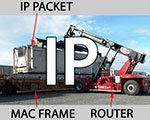
IP Networks, Routers and Addresses is a comprehensive course on IP networking fundamentals: IP packets, IP addressing and IP routers.
We'll see how routers implement the network with packet-switching, that is, relaying packets from one circuit to another, and how routers are a point of control for network security. We'll introduce the term Customer Edge (CE), and understand the basic structure and content of a routing table.
Then we'll cover the many aspects of IP addressing: IPv4 address classes, dotted decimal, static vs. dynamic addresses, DHCP, public vs. private addresses, Network Address Translation, and finish with an overview of IPv6.
Course Lessons
1. Introduction
2. Review: Channelized Time-Division Multiplexing (TDM)
3. Statistical Time-Division Multiplexing: Bandwidth-on-Demand
4. Network: Bandwidth on Demand + Routing
5. Routers
6. IPv4 Addresses
7. DHCP
8. Public and Private IPv4 Addresses
9. Network Address Translation
10. IPv6 Overview
11. IPv6 Address Allocations and Assignment
Based on Teracom’s famous Course 101, tuned and refined over the course of 20 years of instructor-led training, we’ll cut through the jargon to clearly explain IP and routers, packets and addresses, the underlying ideas, and how it all works together… in plain English.
This course is the fifth course in the CTNS Certification Package. Purchase this item to get the individual course.
Course page with full description
The Unlimited Plan gives you unlimited repeats, with no expiration and no monthly fees. One-time payment. Take as long as you like. Jump in and out of lessons, refresh your knowledge in the future.
A course completion certificate is awarded upon passing the course exam.
A reference book is available, in print and eBook.
Course Outline
1. Introduction
Course overview.
2. Review: Channelized Time-Division Multiplexing (TDM)
Traditional TDM inefficiencies
3. Statistical Time-Division Multiplexing: Bandwidth-on-Demand
Overbooking and opportunistic capacity
4. Private Network: Bandwidth on Demand + Routing
How Routers Implement the Network
5. Routers
Routers and routing tables. Packet forwarding and filtering. Customer Edge.
6. IPv4 Addresses
Address classes and dotted-decimal notation.
7. DHCP
Dynamic and static addresses and DHCP
8. Public and Private IPv4 Addresses
How to obtain public addresses, and why private addresses are used
9. Network Address Translation
How a NAT glues private IPv4 addressing in-building to the Internet
10. IPv6 Overview
What’s new, improvements on IPv4 and IPv6 packet format
11. IPv6 Address Allocations and Assignment
Types of IPv6 addresses, registries, allocations, assignment to end-users
12. Multiple-Choice Exam
Teracom is the leader in telecommunications training. In business since 1992, we supply this training to the US government under our GSA schedule contract, which means pre-approved quality and pricing. We're so confident of the quality of this training, it comes with a 30-day money-back guarantee.
$119
Up to date for the 2020s, MPLS and Carrier Networks is a comprehensive training course designed to build a solid understanding of carrier packet networks and services, the terminology, technologies, configuration, operation and most importantly, the underlying ideas… in plain English.
We’ll cut through the buzzwords and marketing to demystify carrier networks and services, explaining Service Level Agreements, traffic profiles, virtual circuits, QoS, Class of Service, MPLS, and how MPLS is used to implement Differentiated Services, integration, convergence and aggregation, and how MPLS relates to TCP/IP and Internet, without bogging down on details.
Course Lessons
1. Introduction
2. Carrier Packet Network Basics
3. Service Level Agreements
4. Virtual Circuits
5. QoS Requirement for Voice over IP
6. MPLS
7. TCP/IP over MPLS
8. Differentiated Classes of Service using MPLS
9. Integration and Convergence using MPLS
10. Managing Aggregates of Traffic with MPLS Label Stacking
11. MPLS Services vs. Internet Service
Based on Teracom’s famous Course 101, tuned and refined over the course of over 25 years of instructor-led training, you will gain career- and productivity-enhancing knowledge of the structure, components and operation of carrier packet networks and services, how they are implemented, packaged and marketed by carriers and how they are used by government, business… and other carriers.
This course is the sixth course in the CTNS Certification Package. Purchase this item to get the individual course.
Course page with full description
The Unlimited Plan gives you unlimited repeats, with no expiration and no monthly fees. One-time payment. Take as long as you like. Jump in and out of lessons, refresh your knowledge in the future.
A course completion certificate is awarded upon passing the course exam.
A reference book is available, in print and eBook.
Course Outline
1. Introduction
Course introduction and overview
2. Carrier Packet Network Basics
Customer Edge, Provider Edge, Access and Network Core
3. Service Level Agreements
Contractual specification: Traffic Profile and Class of Service
4. Virtual Circuits
Traffic Classes and pre-determined routes
5. QoS Requirement for Voice over IP
How packetized voice works and what is needed
6. MPLS
MPLS components, LER, LSP, LSR jargon, basic operation
7. TCP/IP over MPLS
Tracing a file transfer through the equipment and protocols
Implementing Virtual Private LAN Service with MPLS
8. Differentiated Classes of Service using MPLS
Different transmission characteristics for different traffic
9. Integration and Convergence using MPLS
Saving money with Integrated Access
10. Managing Aggregates of Traffic with MPLS Label Stacking
Aggregating similar traffic to be managed as a single entity
11. MPLS Services vs. Internet Service
Understanding the key difference: guarantees or not. The Future.
Teracom is the leader in telecommunications training. In business since 1992, we supply this training to the US government under our GSA schedule contract, which means pre-approved quality and pricing. We're so confident of the quality of this training, it comes with a 30-day money-back guarantee.
$119
Wireless Fundamentals is the first course in the CWA Certification Package.
We begin with the fundamentals: what radio is, how it's organized and how and it's used to communicate information. Since most systems are digital, we spend time understanding how modems represent 1s and 0s on radio, and explain jargon like QAM and QPSK. We finish with propagation, penetration then fading.
Course Lessons
1. Introduction to CWA
2. Radio Fundamentals
3. Wireless Spectrum and Radio Bands
4. Analog Radio
5. Digital Radio: How Modems Work
6. Propagation, Penetration and Fading
Based on Teracom's instructor-led training, tuned and refined over the course of over 20 years, you will gain career- and productivity-enhancing fundamentals in radio - what it is, how it works, what the main technologies are and more.
This course is the first course in the CWA Certification Package. Purchase this item to get the individual course.
Course page with full description
The Unlimited Plan gives you unlimited repeats, with no expiration and no monthly fees. One-time payment. Take as long as you like. Jump in and out of lessons, refresh your knowledge in the future.
A course completion certificate is awarded upon passing the course exam.
Teracom is the leader in telecommunications training. In business since 1992, we supply this training to the US government under our GSA schedule contract, which means pre-approved quality and pricing. We're so confident of the quality of this training, it comes with a 30-day money-back guarantee.
$119
Mobile Communications is the second course in the CWA Certification Package.
This is a comprehensive course on mobile communications from A to Z: cellular principles, digital voice, data over cellular, mobile Internet access, and explaining the technologies: FDMA, TDMA, CDMA and OFDMA, and the generations: 2G GSM, 3G 1X, UMTS and HSPA, 4G LTE and LTE-Advanced, and 5G New Radio.
This is where the money is!
Course Lessons
1. Mobile Network Components and Operation
2. Cellular Principles
3. 1G: Analog Frequency-Division Multiple Access
4. Second Generation: Digital
5. PSTN Calls Using the Native Phone App: "Voice Minutes"
6. Mobile Internet: "Data Plan"
7. Mobile Network Operators, MVNOs & Roaming
8. TDMA (IS-136): Time-Division Multiple Access
9. TDMA (GSM): Time-Division Multiple Access
10. CDMA: Code-Division Multiple Access
11. Spread Spectrum
12. CDMA Operation and Patents
13. 3G: CDMA 1X and UMTS
14. 4G LTE: Mobile Broadband
15. Dynamic Assignment of Subcarriers
16. 5G NR: Enhanced Mobile Broadband, IoT Communications
17. Spectrum-Sharing Roundup: FDMA, TDMA, CDMA, OFDM
Based on Teracom's instructor-led training, tuned and refined over the course of over 20 years, you will gain career- and productivity-enhancing fundamentals in radio - what it is, how it works, what the main technologies are and more.
This course is the second course in the CWA Certification Package. Purchase this item to get the individual course.
Course page with full description
The Unlimited Plan gives you unlimited repeats, with no expiration and no monthly fees. One-time payment. Take as long as you like. Jump in and out of lessons, refresh your knowledge in the future.
A course completion certificate is awarded upon passing the course exam.
Teracom is the leader in telecommunications training. In business since 1992, we supply this training to the US government under our GSA schedule contract, which means pre-approved quality and pricing. We're so confident of the quality of this training, it comes with a 30-day money-back guarantee.
$119
Fixed Wireless is the third and final course in the CWA Certification Package.
This course covers infrared and Bluetooth, Wi-Fi and the 802.11 Wireless LAN standards, the different versions, Wi-Fi security and WPA-2 Personal, point-to-point microwave, 3.5 GHz Broadband Wireless Home Internet, Low-Power Wide-Area (LPWA) technologies and LEO and GEO satellite communications.
Course Lessons
1. Infrared
2. Bluetooth
3. Wi-Fi: Wireless LANs
4. Wi-Fi Security and WPA2
5. Point-to-Point Microwave
6. 3.5 GHz Broadband Wireless Internet
7. Low-Power Wide Area (LPWA) Networks
8. Satellite Communications
Based on Teracom's instructor-led training, tuned and refined over the course of over 20 years, you will gain career- and productivity-enhancing fundamentals in radio - what it is, how it works, what the main technologies are and more.
This course is the third and final course in the CWA Certification Package. Purchase this item to get the individual course.
Course page with full description
The Unlimited Plan gives you unlimited repeats, with no expiration and no monthly fees. One-time payment. Take as long as you like. Jump in and out of lessons, refresh your knowledge in the future.
A course completion certificate is awarded upon passing the course exam.
Teracom is the leader in telecommunications training. In business since 1992, we supply this training to the US government under our GSA schedule contract, which means pre-approved quality and pricing. We're so confident of the quality of this training, it comes with a 30-day money-back guarantee.
$119
VoIP Architectures and Implementation Choices is a comprehensive overview of the many flavors of VoIP, comparing and contrasting the various implementation and architecture choices.
Progressing from talking between computers over the Internet through Internet telephony, Managed IP Telephony, PBX replacement with distributed call manager systems and IP Centrex / Hosted PBX, you'll gain the knowledge to confidently differentiate VoIP architectures and discuss pros and cons of options.
Course Lessons
1 Intro + Internet Telephony: Computer-Computer VoIP over the Internet
2 Internet Telephony Example: Skype
3 VSPs: Internet to Phone e.g. Gmail Client
4 VSP Phone to Phone over Internet e.g. Vonage
5 VoIP Becomes The New POTS
6 VoIP at Carriers
7 VoIP-Enabled PBX and Migration Options
8 Premise Softswitch: PBX Replacement
9 Cloud Services and Hosted PBX: Softswitch as a Service (SaaS)
10 IP Centrex
11 Asterisk and Open-Source Softswitch Software
12 IP Phone Features and Uses
Based on Teracom’s famous Course 130, tuned and refined over the course of over 20 years of instructor-led training, you will gain career- and productivity-enhancing knowledge of all of the different things someone could mean when they say "Voice over IP", and the pros and cons of each.
Course page with full description
The Unlimited Plan gives you unlimited repeats, with no expiration and no monthly fees. One-time payment. Take as long as you like. Jump in and out of lessons, refresh your knowledge in the future.
A course completion certificate is awarded upon passing the course exam.
Teracom is the leader in telecommunications training. In business since 1992, we supply this training to the US government under our GSA schedule contract, which means pre-approved quality and pricing. We're so confident of the quality of this training, it comes with a 30-day money-back guarantee.

$119
Softswitches, SIP and Call Setup is all about how VoIP phone calls are set up using messages and procedures complying with the standard Session Initiation Protocol.
In this course, you'll understand what SIP is, how it works, demystify jargon like proxy server and location server, understand how SIP fits in with softswitches and call managers, and trace the establishment of an IP phone call step by step.
Course Lessons
1 Intro + What SIP Is and What It Can Do
2 SIP's Relationship to Other Protocols
3 SIP URIs: Telephone Numbers
4 Register: Update Your Location
5 INVITE: Dialing
6 Location Service: Finding the Far End
7 The SIP Trapezoid
8 SIP Messages and the Session Description Protocol
9 How SIP Relates to Softswitches and Call Managers
Based on Teracom’s famous Course 130, tuned and refined over the course of over 20 years of instructor-led training, you will gain career- and productivity-enhancing knowledge of how SIP is used to set up a VoIP phone call end-to-end, and how SIP fits in with call managers and softswitches.
Course page with full description
The Unlimited Plan gives you unlimited repeats, with no expiration and no monthly fees. One-time payment. Take as long as you like. Jump in and out of lessons, refresh your knowledge in the future.
A course completion certificate is awarded upon passing the course exam.
Teracom is the leader in telecommunications training. In business since 1992, we supply this training to the US government under our GSA schedule contract, which means pre-approved quality and pricing. We're so confident of the quality of this training, it comes with a 30-day money-back guarantee.
$119
Voice Packetization, Codecs and Voice Quality is the "nuts and bolts" of Voice over IP: how the voice is digitized and coded, time stamps applied with the RTP protocol, and how the result is carried in UDP, IP packets and MAC frames.
You'll learn about codecs and compression, and understand factors like delay, jitter and packet loss, what causes them, and how they affect sound quality. Sample sound clips with lost packets and uncorrected timing variations are included so you can hear the effects.
Course Lessons
1 Voice Packetization
2 Measuring Voice Quality
3 Factors Affecting Voice Quality
4 Codecs: Voice Coding and Compression
5 Delay
6 Jitter
7 RTP
8 Protocol Stack: RTP, UDP, IP, MAC
9 Packet Loss
10 Tips for Maximizing Voice Quality
Based on Teracom’s famous Course 130, tuned and refined over the course of over 20 years of instructor-led training, you will gain career- and productivity-enhancing knowledge of how packetized voice is actually implemented and the factors affecting sound quality.
Course page with full description
The Unlimited Plan gives you unlimited repeats, with no expiration and no monthly fees. One-time payment. Take as long as you like. Jump in and out of lessons, refresh your knowledge in the future.
A course completion certificate is awarded upon passing the course exam.
Teracom is the leader in telecommunications training. In business since 1992, we supply this training to the US government under our GSA schedule contract, which means pre-approved quality and pricing. We're so confident of the quality of this training, it comes with a 30-day money-back guarantee.

$119
SIP Trunking & Carrier Connections is all about connecting to carriers to communicate VoIP phone calls, both carrier-to-carrier connections and business-to-carrier SIP trunking.
You'll learn how currently the only way for a competitive carrier to terminate a phone call on a Local Exchange Carrier to connect a VoIP call to someone with POTS is at the DS0 level using a gateway. We'll understand why this will be a native VoIP connection in the future, and the role of Session Border Controllers. Then we'll understand how a business can connect to the telephone system using a gateway and PBX trunks, and the advantages of the newer SIP Trunking services for business to PSTN connection.
Course Lessons
1 Introduction + Carrier-Carrier Connection via DS0
2 Carrier-Carrier VoIP Interconnection
3 Session Border Controllers
4 Business PSTN Connection using PBX Trunks and Gateway
5 Softswitch Controlling the Gateway
6 SIP Trunking: Native VoIP Connection
Based on Teracom’s famous Course 130, tuned and refined over the course of over 20 years of instructor-led training, you will gain career- and productivity-enhancing knowledge of how connections are made to carriers, both for business-PSTN connections and carrier-carrier connections.
Course page with full description
The Unlimited Plan gives you unlimited repeats, with no expiration and no monthly fees. One-time payment. Take as long as you like. Jump in and out of lessons, refresh your knowledge in the future.
A course completion certificate is awarded upon passing the course exam.
Teracom is the leader in telecommunications training. In business since 1992, we supply this training to the US government under our GSA schedule contract, which means pre-approved quality and pricing. We're so confident of the quality of this training, it comes with a 30-day money-back guarantee.
$119
IP Network Quality CoS, QoS, MPLS and Diff-Serv focuses on the network service provided by carriers to move packets containing voice, and how network traffic is identified, managed and prioritized, resulting in Class of Service offerings to meet Service Level Agreements.
You will learn how carriers use virtual circuits to manage flows of IP packets, and how MPLS is used to do this. You will understand the idea of Differentiated Services: different transmission characteristics for different kinds of traffic, and how these are implemented as Classes of Service (CoS). We'll cover Service Level Agreements and how "throttling" some users is sometimes necessary to ensure all users are getting the CoS they are paying for. We'll cover the Quality of Service (QoS) mechanisms MPLS and 802.1P and how Classes of Service are implemented by routers.
Course Lessons
1 Course Introduction + Virtual Circuit Technologies
2 MPLS
3 Differentiated Services (Diff-Serv)
4 Service Level Agreements, Meters, Markers, Shapers and Droppers
5 Interworking Diff-Serv and MPLS
6 Using 802.1P for QoS
7 Implementing CoS: Queuing Techniques
Based on Teracom’s famous Course 130, tuned and refined over the course of over 20 years of instructor-led training, you will gain career- and productivity-enhancing knowledge of network quality, how it is specified and implemented.
Course page with full description
The Unlimited Plan gives you unlimited repeats, with no expiration and no monthly fees. One-time payment. Take as long as you like. Jump in and out of lessons, refresh your knowledge in the future.
A course completion certificate is awarded upon passing the course exam.
Teracom is the leader in telecommunications training. In business since 1992, we supply this training to the US government under our GSA schedule contract, which means pre-approved quality and pricing. We're so confident of the quality of this training, it comes with a 30-day money-back guarantee.
$119
In this course, you’ll build a solid understanding of the fundamentals of the Public Switched Telephone Network (PSTN): customer premise and Central Office, loops, trunks, remotes, circuit switching and how a telephone call is connected end-to-end. We’ll cover LECs and IXCs, and Plain Ordinary Telephone Service and how it's implemented with sound, analogs, the voiceband, twisted pair, DTMF, loops, trunks and SS7 ISUP signaling.
Then, we will understand how this voice is carried in IP packets: Voice over IP (VoIP), and what will happen next: the Internet and the telephone network will become the same thing, and basic telecom service is called Broadband IP Dial Tone.
In the meantime, there are hundreds of millions of POTS lines still in service, still being maintained and still generating revenue for carriers. This will not disappear overnight, but will continue to be supported for many years to come, until the last POTS line is disconnected.
Broadband Internet service is provided using DSL modems over the wires put in place for POTS.
Even if we were to move to an all-Voice-over-IP network, at least the last foot will still be analog: at residences, a cable modem or fiber terminal performs the functions of a POTS line card: power, dial tones, ringing and analog signals to regular phones via the telephone wires inside the house.
At a business, the analog-digital conversion might happen inside a VoIP telephone plugged onto the LAN - but the signals on the curly cord attached to the handset are still analog.
Many VoIP systems digitize voice at 64 kb/s, a bit rate that is directly related to the voiceband defined for analog POTS. Legacy SONET and SDH fiber-optic transmission infrastructure are organized into 64 kb/s channels.
There is a huge inertia of regulations, tariffs, accounting and money involved in the interconnect between local exchange carriers (the “last mile”), and inter-exchange carriers, (the “long distance”), that is based on Tandem Access Trunks, channelized PSTN circuit-switched technology.
Understanding channels and circuit-switching is still necessary to know how a phone call from a cellphone on a wireless network connects to a phone plugged into a competitor’s cable modem in another city.
The structure, components and operations described in this course were built worldwide, in every country on earth, during the period 1970 - 2000. Though circuit-switching has been eclipsed by IP packet switching, the installed base continues to generate revenue. Besides, to this day, a PSTN network address (your ten-digit phone number) is required to be able to receive a phone call from anyone! Lesson 10 explains how that will change.
Course Lessons
1. Introduction
2. History of Telecommunications (USA and Canada)
3. The Public Switched Telephone Network (PSTN)
4. Analog Circuits and Sound
5. The Voiceband
6. Plain Ordinary Telephone Service (POTS)
7. Signaling: Pulse Dialing and Dual Tone Multiple Frequency (DTMF)
8. Signaling System 7 (SS7)
9. Voice in IP Packets
10. IP Dial Tone
Based on Teracom’s famous Course 101, tuned and refined over the course of 20 years of instructor-led training, we’ll cut through the jargon to demystify telephony and the telephone system, explaining the jargon and buzzwords, the underlying ideas, and how it all works together… in plain English.
Featuring many photos of actual equipment both inside a Central Office and in the outside plant, this multimedia course is an excellent way to get up to speed on traditional telephony.
This course is the first course in the CTNS Certification Package. Purchase this item to get the individual course.
Course page with full description
The Unlimited Plan gives you unlimited repeats, with no expiration and no monthly fees. One-time payment. Take as long as you like. Jump in and out of lessons, refresh your knowledge in the future.
A course completion certificate is awarded upon passing the course exam.
Study Guide: Telecom 101 textbook. Available in print and eBook.
Course Outline
1. Introduction
Course overview
2. History of Telecommunications (USA and Canada)
Local phone companies, long distance; Bell System, breakup, LECs and IXCs; Canada
3. The Public Switched Telephone Network (PSTN)
Loops and trunks, CO, customer premise, circuit-switching, outside plant, loop length, remotes
4. Analog Circuits and Sound
What analog means, microphones, speakers, copper wires and electricity, sound: trees falling in the forest
5. The Voiceband
Reproducing thoughts vs. reproducing sound, frequency range, filters, limitations
6. Plain Ordinary Telephone Service (POTS)
Twisted pair, dial tone, ringing, supervision, lightning protection
7. Signaling: Pulse Dialing and Dual Tone Multiple Frequency (DTMF)
Dial-up, make-or-break signaling, touch-tone, DTMF, in-band signaling
8. Signaling System 7 (SS7) Control system for the PSTN, SCPs and SSPs, examples of sophisticated call routing
9. Voice in IP Packets
How Voice over IP (VoIP) moves a phone call end-to-end
10. IP Dial Tone
The Internet and the PSTN will be the same thing in the not-too-distant future. Basic telecom service will be not POTS but rather Broadband IP Dial Tone.
11. Multiple Choice Exam
Teracom is the leader in telecommunications training. In business since 1992, we supply this training to the US government under our GSA schedule contract, which means pre-approved quality and pricing. We're so confident of the quality of this training, it comes with a 30-day money-back guarantee.
$119
In this course, we'll review the telecommunications industry and understand the main players and competitors, how Local Exchange Carriers connect to Inter-Exchange Carriers and how CLECs fit into the picture.
Course Lessons
1. US Domestic Telcos
2. AT&T and Verizon
3. Canadian Telephone Companies
4. PSTN Switching Centers Before Competition
5. Accessing The Interexchange Carriers
6. Competitive Local Exchange Carriers (CLECs)
Based on Teracom’s famous Course 101, tuned and refined over the course of 20 years of instructor-led training, we’ll cut through the jargon to demystify telephony and the telephone system, explaining the jargon and buzzwords, the underlying ideas, and how it all works together… in plain English.
This course is the third course in the CTA Certification Package. Purchase this item to get the individual course.
Course page with full description
The Unlimited Plan gives you unlimited repeats, with no expiration and no monthly fees. One-time payment. Take as long as you like. Jump in and out of lessons, refresh your knowledge in the future.
A course completion certificate is awarded upon passing the course exam.
Study Guide: Telecom 101 textbook. Available in print and eBook.
Course Outline
1. US Domestic Telcos
The formation and breakup of the Bell System; LECs, IXCs and switched access
2. AT&T and Verizon
How the Bell System was reconstituted in 2 1/2 pieces
3. Canadian Telephone Companies
From provincial telephone companies to Bell and TELUS
4. PSTN Switching Centers Before Competition
The 5-level switching hierarchy; Class 5 COs and Class 4 Toll Centers
5. Accessing The Interexchange Carriers
Switched access at the Toll Center; 1010xxx carrier codes, PIC table
6. Competitive Local Exchange Carriers (CLECs)
Collocation and dark fiber
9. Multiple-choice Exam
Teracom is the leader in telecommunications training. In business since 1992, we supply this training to the US government under our GSA schedule contract, which means pre-approved quality and pricing. We're so confident of the quality of this training, it comes with a 30-day money-back guarantee.
$119
In this course, we'll begin by establishing a model for a data communications circuit, the components of the model, and what each does to move bits from one device to another. Then, we'll explore different circuit configurations including LANs MAC addresses, and WANs of routers, circuits and IP addresses.
Course Lessons
1. Data Circuit Model
2. Data Terminal Equipment (DTE)
3. Analog and Digital Data Circuits
4. Data Circuit Terminating Equipment (DCE)
5. Configuration Example: Point-to-Point
6. Multidrop Circuits
7. LANs
8. Wide Area Networks
Based on Teracom’s famous Course 101, tuned and refined over the course of 20 years of instructor-led training, we’ll cut through the jargon to demystify telephony and the telephone system, explaining the jargon and buzzwords, the underlying ideas, and how it all works together… in plain English.
This course is the seventh course in the CTA Certification Package. Purchase this item to get the individual course.
Course page with full description
The Unlimited Plan gives you unlimited repeats, with no expiration and no monthly fees. One-time payment. Take as long as you like. Jump in and out of lessons, refresh your knowledge in the future.
A course completion certificate is awarded upon passing the course exam.
Study Guide: Telecom 101 textbook. Available in print and eBook.
Course Outline
1. Data Circuit Model
Coding thoughts into bits, then representing them on a physical medium.
2. Data Terminal Equipment (DTE)
The source and sink of the bits
3. Analog and Digital Data Circuits
Modulation of a carrier frequency vs. digital pulses
4. Data Circuit Terminating Equipment (DCE)
Modems, LAN interfaces
5. Configuration Example: Point-to-Point
Serial and parallel. Serial port function.
6. Multidrop Circuits
Controllers and controlees: unbalanced data link configuration
7. LANs
Broadcast domains: balanced data link configuration, MAC addresses
8. Wide Area Networks
Networks, routers and IP addresses
9. Multiple-choice Exam
Teracom is the leader in telecommunications training. In business since 1992, we supply this training to the US government under our GSA schedule contract, which means pre-approved quality and pricing. We're so confident of the quality of this training, it comes with a 30-day money-back guarantee.
$119
IP Security
Based on Teracom’s famous Course 130, tuned and refined over the course of over 20 years of instructor-led training, you will gain career- and productivity-enhancing knowledge of IP Security and all its aspects from firewalls to encryption.
Course page with full description
The Unlimited Plan gives you unlimited repeats, with no expiration and no monthly fees. One-time payment. Take as long as you like. Jump in and out of lessons, refresh your knowledge in the future.
A course completion certificate is awarded upon passing the course exam.
Teracom is the leader in telecommunications training. In business since 1992, we supply this training to the US government under our GSA schedule contract, which means pre-approved quality and pricing. We're so confident of the quality of this training, it comes with a 30-day money-back guarantee.
$119
We’ll start at the beginning of the story, understanding where the Internet came from and its fundamental principles of operation. Then we’ll look at some details and improvements such as the Domain Name System, MIME, HTML and HTTP... which form “the Web”. We’ll review how you can connect to the Web from a residence and from an enterprise or organization.
Course Lessons
1. Internet History
2. Internet Basics
3. TCP and UDP
4. Internet Service Providers
5. Commonly Used Internet Protocols
6. Domain Name System
7. MIME and Base-64 Encoding
8. World Wide Web
9. HTML, HTTP and HTTPS
10. Accessing the Internet: Home Connections
11. Accessing the Internet: Organization Connections
Based on Teracom’s famous Course 101, tuned and refined over the course of 20 years of instructor-led training, we’ll cut through the jargon to demystify telephony and the telephone system, explaining the jargon and buzzwords, the underlying ideas, and how it all works together… in plain English.
This course is the third course in the CTA Certification Package. Purchase this item to get the individual course.
Course page with full description
The Unlimited Plan gives you unlimited repeats, with no expiration and no monthly fees. One-time payment. Take as long as you like. Jump in and out of lessons, refresh your knowledge in the future.
A course completion certificate is awarded upon passing the course exam.
Study Guide: Telecom 101 textbook. Available in print and eBook.
Course Outline
1. Internet History
A network to survive nuclear war. Not.
2. Internet Basics
The Inter-Net and Routing Tables
3. TCP and UDP
Reliable communications; or not; port numbers
4. Internet Service Providers
Internet Exchanges, Tier-1 providers, transit and peering
5. Commonly Used Internet Protocols
TCP, IP, SMTP, FTP, ...
6. Domain Name System
Domains and Zone Files
7. MIME and Base-64 Encoding
Sending pictures as text in emails
8. World Wide Web
Client-server computing over the Internet
9. HTML, HTTP and HTTPS
Protocols for web servers and web pages
10. Accessing the Internet: Home Connections
Broadband Internet
11. Accessing the Internet: Organization Connections
Gigabit Ethernet Internet Service
12. Multiple-choice Exam
Teracom is the leader in telecommunications training. In business since 1992, we supply this training to the US government under our GSA schedule contract, which means pre-approved quality and pricing. We're so confident of the quality of this training, it comes with a 30-day money-back guarantee.


