Go to Teracom home page List of all courses and scheduled public seminars detailed info on self-paced DVD and video courses info on bringing any Teracom seminar to your location for a private team training session online and downloadable telecommunications training No bookshelf is complete without our Telecom 101 reference handbook Go to your myTeracom home page for the menu of free stuff
Teracom logo
 

TELECOM BOOK


site map
QUICK LINKS
Order books
Telecom 101 home page
Courses
Computer-Based Training
DVD video courses
Bring any course to you
Free tutorials
Previews
Free newsletter
Member specials
 TERACOM
Value pricing comparison
Why take our courses
Who will benefit
Read the reviews
Instructors
About Teracom
About myTeracom
Site map
Policies and FAQs
CPE credits
Contact us
Telecom 101 Textbook and eBook - Outline
    Take a look at the full Table of Contents from the new edition!
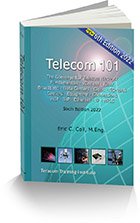
  Totally updated - January 2008 - this all-in-one telecom book can be used as a self-study guide, day-to-day reference or course textbook.
  Whether you need a certification, Continuing Professional Education credits or most importantly, career-enhancing understanding of the concepts, technologies, major components and protocols... and how it all fits together, this telecom book is a priceless resource.
 

Many of the chapters of this telecom book are actually self-contained references on subject areas such as telephony, T1, LANs, Voice over IP and many more.

Instead of having to purchase multiple reference books from different authors to explain each of these topics, you get them all, bound in a single volume, in a consistent style and quality, for one low price.  Order today to obtain this invaluable reference!

Order online  Order with check / PO  PDF brochure  DVD-video version  Print this

Telecom 101  Third Edition

ISBN 978-1-894887-01-4  400 pages, 177 diagrams, full index. Published January 2008

Part I  Fundamentals of Telecommunications

The first part covers the Public Switched Telephone Network, equipment and call centers, the telecom business, carriers, digital voice transmission, T1, fiber and SONET backbones, how digital circuits and services are provided, muxes vs. switches vs. routers and wireless … the groundwork for understanding everything.

Chapter 1  Introduction

Chapter 1 is an introduction. We discuss the approach taken in organizing the topics, and suggestions for how to use the material. This chapter contains an initial framework for understanding telecom circuits and services, and introductory terminology, jargon and buzzwords.

1.1 Our Approach

1.2 How the Text is Organized

1.3 How to Use This Text

1.4 The Three Answers

1.4.1 Answer Number 1: Money

1.4.2 Answer Number 2: History

1.4.3 Answer Number 3: It's All Pretty Much the Same Thing

1.5 Telecommunications Services from the User's Point of View

1.5.1 Access Circuits

1.5.2 Network Connection

1.5.3 Billing Plan

1.6 The Network “Cloud”

1.7 Telecom Circuits from the Phone Company's Point of View

1.7.1 Access Network

1.7.2 Switching Centers

1.7.3 Transmission Network

1.8 What's Next

Chapter 2  Fundamentals of Telephony

Whether you're interested in telecom, datacom, wireless, Wide Area Networking or Voice over IP, everything begins with the Public Switched Telephone Network and Plain Ordinary Telephone Service. We'll begin with a model for the PSTN, explaining analog circuits and circuit switching, as well as common telephony buzzwords and jargon, and an overview of SS7.

2.1 History of Telecommunications

2.1.1 Invention of the Telephone

2.1.2 Local Phone Companies

2.1.3 The Bell System

2.1.4 The Rest of the World

2.2 PSTN: Public Switched Telephone Network

2.2.1 Basic Model of the PSTN

2.2.2 Loops

2.2.3 Remotes

2.2.4 Trunks and Circuit Switching

2.3 Analog Signals and Analog Circuits

2.4 Capacity Restrictions on the Loop

2.4.1 What is Speech?

2.4.2 The Voiceband

2.4.3 Bandwidth

2.5 Problems with Analog Transmission

2.5.1 Attenuation and Amplifiers

2.5.2 Noise

2.6 Plain Ordinary Telephone Service

2.6.1 Twisted Pair

2.6.2 Components of a Telephone

2.6.3 Supervision

2.6.4 Call Progress Tones

2.7 Network Addresses: Telephone Numbers

2.7.1 Area Codes

2.7.2 Pulse Signaling

2.7.3 DTMF Address Signaling

2.8 SS7: Signaling System 7

2.8.1 Advanced Intelligent Network (AIN)

2.8.2 AIN Services

2.9 Summary

Chapter 3  Telecom Equipment

We’ll round out our discussion of telephony with a practical overview of different types of equipment that can be connected to the telephone network. Without bogging down on details, we'll sort out switches, PBXs, ACDs, IVRs, Call Centers and modems, including a discussion of DSL and how it is provided.

3.1 Telephone Switches

3.1.1 PBXs

3.1.2 Centrex

3.2 Computer-Telephony Integration

3.2.1 Voice Mail

3.2.2 IVR: Interactive Voice Response System

3.2.3 ACD: Automated Call Distributor

3.2.4 Inbound Call Centers

3.3 Modems and DSLAMs

3.3.1 Voiceband Modems

3.3.2 Bits per Hertz?

3.3.3 DSL: “Digital Subscriber Lines”

3.3.4 DSL Equipment

Chapter 4  The Telecommunications Industry

A practical overview of the telecommunications industry: service providers and alliances, competitive forces, structure and regulation; resellers, IXCs, LECs and CLECs.

4.1 US Domestic Telcos

4.1.1 LECs and LATAs: Local Exchange Carriers

4.1.2 IXCs: Inter-Exchange Carriers

4.1.3 Resellers

4.1.4 Consolidation

4.2 Canadian Telephone Companies

4.3 Trunks and Switching Centers

4.4 Network Access for Long-Distance

4.4.1 POP: Point of Presence

4.4.2 Equal Access

4.5 CLECs: Competitive Local Exchange Carriers

4.5.1 DSL from CLECs

4.5.2 Voice over DSL

Chapter 5  Digital Communications

This chapter will give you a real understanding of what "digital" means, and how it is implemented. We'll explain what a "DS0" is, and take a practical tour of digital circuits, including T1, T3, SONET and ISDN. At a high level, we'll see how voice, data and video can be integrated.

5.1 Why Digital?

5.1.1 Multiplexing

5.1.2 Noise Performance

5.1.3 Storage and Processing

5.1.4 Integration and Convergence

5.2 Analog and Digital: What do we really mean?

5.2.1 Analog

5.2.2 Bandwidth: Analog Circuits

5.2.3 Digital

5.2.4 Bandwidth: Digital Circuits

5.3 Continuous vs. Discrete Signals

5.3.1 Continuous and Analog

5.3.2 Discrete and Digital

5.4 Voice Digitization (Analog-Digital Conversion)

5.4.1 Quantization

5.4.2 Sampling

5.4.3 Coding

5.4.4 End to End: Analog-Digital-Analog

5.4.5 Quantization Errors

5.5 DS0: Voice Digitization on the PSTN

5.5.1 Quantization: 256 Levels

5.5.2 Sampling: 8,000 Samples per Second

5.5.3 Coding: 8 Bits Per Sample

5.5.4 The DS0 Rate

5.6 The Digital Hierarchy: Standard Line Speeds

5.6.1 DS1

5.6.2 DS3

5.6.3 STM

5.7 Technologies: Digital Carrier Systems

5.7.1 T1

5.7.2 T3: “Asynchronous” DS3 Multiplexing

5.7.3 SONET: Synchronous DS3 Multiplexing

5.7.4 SDH

5.7.5 T1 vs. DS1 and T3 vs. DS3

5.8 ISDN

5.8.1 ISDN Basic Rate Interface (BRI)

5.8.2 ISDN Primary Rate Interface (PRI)

5.8.3 PBX Trunks on T1 vs. ISDN PRI

5.9 Using Digital Circuits: Applications

5.9.1 Voice on Digital Circuits

5.9.2 Voice Compression

5.9.3 Data Applications

5.9.4 Digital Video

5.10 Summary: Integration: Voice, Video, Data

Chapter 6  Transmission Systems

Time Division Multiplexing (TDM) and digital carrier systems are the technologies at the heart of telecommunications networks. We'll provide you with a basic understanding of how transmission systems work, both over copper wires and over fiber, and an overview of SONET and optical networking. We'll explain the "network cloud": how circuits are actually provided by carriers, the difference between multiplexers, switches and routers and what services these are used for.

6.1 Time Division Multiplexing

6.1.1 Channelized or “Synchronous” TDM

6.1.2 “Statistical” TDM or “Bandwidth on Demand”

6.2 Channelized TDM: Channels and Framing

6.2.1 Subrate Multiplexing

6.3 Anatomy of a Service

6.3.1 Access Circuits

6.3.2 Network Connection

6.3.3 Billing Plan

6.4 Common Carriers' Transmission Networks

6.4.1 The Network “Cloud”

6.4.2 Fiber Optics

6.4.3 Representing Bits on Fiber

6.4.4 Fiber and Fiber Cable Construction

6.4.5 Redundancy and Protection: Rings

6.4.6 Dark Fiber

6.5 SONET: “Backbone” Transmission Networks

6.5.1 SONET and the Optical Carrier

6.5.2 SONET Rings

6.5.3 DWDM: Dense Wave Division Multiplexing

6.5.4 Next: Fiber Access

6.6 How Circuits are Actually Provided

6.6.1 Inside the Cloud: Core and Edge

6.7 Network Equipment

6.7.1 Multiplexers

6.7.2 Switches

6.7.3 Routers

6.7.4 ATM Switches or ATM Routers?

6.8 Summary

Chapter 7  T1

This chapter covers T1 technology and application in detail. We'll cover T1's origins, concepts such as framing and AMI line codes, and understand what repeaters are for and why this is superior to analog. We'll also cover B8ZS and clear channels, HDSL, cross-connects, fractional T1 and CSU/DSUs.

7.1 T1 History and Current Applications

7.2 Basic T1 Circuit Components

7.3 T1 Framing

7.3.1 Superframe Format

7.3.2 ESF

7.4 Pulses and Line Code: AMI

7.4.1 Repeaters

7.5 Synchronization: Bit-Robbing

7.5.1 56 kb/s for Data

7.6 B8ZS and 64 kb/s Clear Channels

7.7 How T1 Is Provided

7.7.1 HDSL

7.8 Fractional T1 and Cross-Connects

7.9 Subrate Data Circuits 1.2 kb/s to 56 kb/s

7.9.1 CSUs, DSUs and CSU/DSUs

Chapter 8  Wireless Communications

We'll round out your knowledge of telecom fundamentals with wireless. We'll cover jargon and buzzwords in the mobility business, the idea of cellular, and sort out different cellular technologies, understand CDMA vs. TDMA/GSM and 3G 1x vs. UMTS and 1XEV-DO vs. HSPA. We’ll conclude with an overview of satellite communications, Wi-Fi and WiMAX.

8.1 Radio Transmission

8.2 Mobile Networks

8.3 AMPS: Analog Cellular

8.4 PCS: Personal Communication Services

8.4.1 Wireless PBXs

8.5 Digital Cellular: Voice Communications

8.6 Sharing the Radio Bands

8.6.1 AMPS

8.6.2 TDMA, GSM and GPRS

8.6.3 CDMA

8.7 3G

8.8 Satellite-Based Services

8.8.1 Geosynchronous Satellites

8.8.2 Low Earth Orbit

8.9 Wireless LANs

8.9.1 IEEE 802.11 Standards

8.10 802.16 WiMAX

Chapter 9  Voice Services and Jargon

This chapter provides a summary and overview of voice communication services from carriers, and explains jargon like VPNs, WATS and AIN.

9.1 Local Voice Services

9.1.1 POTS and Party Lines

9.1.2 CLASS Services

9.1.3 Local Measured Service

9.1.4 Public Coin Telephone Service

9.1.5 Directory Services

9.1.6 Business Services

9.1.7 Access

9.2 Long Distance Voice Services

9.2.1 Operator Services

9.2.2 Foreign Exchange

9.2.3 OPX: Off-Premise Extension

9.2.4 Tie Line

9.2.5 Private Networks

9.2.6 WATS

9.2.7 AIN Services

9.2.8 Virtual Private Voice Networks

Part II  Understanding Data Communications

The second part covers datacom basics including the crucial concepts of IP packets and LAN frames; all about modems including DSL and cable modems, data over digital cellular and finishes with LANs: building blocks for Part III.

Chapter 10  Introduction to Data Communications and Networking

We'll start off on the right foot with a solid grounding in data communications and networking basics, introducing and defining key concepts explored in subsequent chapters. We'll start at the beginning, reviewing the components of a data circuit: DTEs, DCEs and physical connections, then explore practical examples of circuits and networks, allowing you to categorize and compare the different types of equipment and circuit configurations.

10.1 Information Theory

10.2 Data Circuit Model

10.3 DTE: Data Terminal Equipment

10.3.1 Dumb Terminals

10.3.2 Intelligent Terminals

10.4 Analog and Digital Data Circuits

10.4.1 Analog Data Circuits

10.4.2 Unloaded Circuits

10.4.3 Wet vs. Dry Circuits

10.4.4 Broadband or Wideband Analog

10.4.5 Digital Circuits

10.4.6 Fiber: Analog or Digital?

10.5 DCE: Data Circuit-Terminating Equipment

10.5.1 Analog DCE: Modems

10.5.2 Digital DCE: CSUs, DSUs, and More

10.6 Point-to-Point Circuits

10.6.1 Parallel

10.6.2 Serial

10.7 Multidrop Circuits

10.7.1 IBM Mainframe Circuits

10.7.2 Cable Television Distribution

10.8 LANs: Local Area Networks

10.9 Wide Area Networks

10.9.1 Basic Components of a WAN

10.9.2 Routers, Network Addresses and Packets

10.10 TCP/IP for Networking

Chapter 11  How Data is Formatted for Transmission

In this chapter, we'll put in place a solid understanding of the key concepts of IP packets and LAN frames, beginning with the fundamentals, to ensure that you have a solid foundation on which to build an understanding of routers, bandwidth-on-demand services and the Internet.

11.1 Basics

11.1.1 Bits

11.1.2 Bytes

11.1.3 Words

11.1.4 Control and Data

11.2 Number Systems

11.2.1 Decimal

11.2.2 Binary

11.2.3 Hexadecimal

11.2.4 Common Use for Hexadecimal

11.3 “Asynchronous”

11.3.1 Coding, Framing and Error Control

11.3.2 ASCII Code Set

11.3.3 Extended ASCII

11.3.4 EBCDIC

11.3.5 Framing: Start and Stop Bits

11.3.6 Parity Checking

11.3.7 No Parity

11.4 Frames:“Synchronous”

11.4.1 Exchanging Frames

11.4.2 Components of a Frame

11.4.3 CRC: Cyclic Redundancy Checking

11.5 Packets

11.6 Packets vs. Frames

11.7 IP Packets

Chapter 12  Modems

Understand how modems transmit 1s and 0s over analog circuits. We'll explain the techniques all modems use, jargon like baud rate and half duplex, and review current voiceband modem standards and what connection speeds to expect.

12.1 Data over the PSTN

12.1.1 Recap: Circuit-Switching and the PSTN

12.1.2 Recap: The Voiceband

12.1.3 Why Not Use Pulses?

12.2 Representing Data in the Voiceband

12.2.1 Amplitude Shift Keying (ASK)

12.2.2 Frequency Shift Keying (FSK)

12.2.3 Phase Shift Keying (PSK)

12.2.4 Quadrature PSK

12.2.5 Quadrature Amplitude Modulation

12.2.6 Trellis-Coded Modulation

12.2.7 Theoretical Maximum

12.3 Modulation Summary

12.4 Voiceband Modem Standards

12.4.1 V.34 Modems

12.4.2 “56K” Modems

12.5 Negotiation and Handshaking

12.6 Modem Control and the AT Command Set

12.7 Modem Jargon and Buzzwords

12.7.1 Baud vs. Bits/Second

12.7.2 Half-Duplex and Full-Duplex

12.8 Factors Limiting Modem Data Rates

12.8.1 Crosstalk and NEXT

12.8.2 Harmonics

12.8.3 A/D Conversion Noise

12.8.4 Voice Compression

12.8.5 Impulse Noise: Spikes

Chapter 13  Broadband Modems

An in-depth overview of high-capacity or "broadband" technologies: DSL and Cable modems, and discuss the age-old question: which is faster? We'll also explore the next generations of DSL, how data over digital cellular works as well as reviewing broadband wireless.

13.1 DSL

13.1.1 ADSL vs. SDSL vs. XDSL

13.1.2 DSLAMs and Co-Location

13.1.3 “Always On”

13.1.4 Advantages of DSL

13.1.5 DSL Modulation Techniques

13.1.6 Loop Length Limitations

13.1.7 Next Generations of DSL

13.1.8 VDSL and OPI DSLAMs

13.2 Cable Modems

13.2.1 CATV Network Architecture

13.2.2 Two-way Communications

13.2.3 Sharing the Access Circuit

13.3 Which Is Faster, Cable Modem Or DSL?

13.4 Data over Analog Cellular

13.5 Data over Digital Cellular

13.5.1 Recap: Digital Cellular for Voice

13.5.2 Communicating Data Instead of Voice

13.5.3 Navigation Servers

13.5.4 WAP and XML

13.5.5 3G

13.6 WiFi and WiMAX

Chapter 14  Understanding LANs

LANs: Local Area Networks are the technology used to connect computers - and in the future telephones - inside the building. We'll complete this module with a basic, solid understanding of LANs: Ethernet and the original idea of a bus, how this changed to 100 Mb/s and now Gigabit Ethernet connected with LAN switches. You'll learn about categories of cables, hubs and switches, and as a preview of Part III, how to interconnect LANs using routers and TCP/IP.

14.1 Categories of Cables

14.1.1 TIA-568A vs. TIA-568B

14.2 Bus Topology

14.2.1 Network Interface Cards and MAC Addresses

14.2.2 Frames and Logical Link Control

14.2.3 What Makes a LAN a LAN

14.2.4 Access Control: CSMA-CD

14.3 802.3 and Ethernet

14.4 Evolution of Ethernet

14.4.1 10BASE-5

14.4.2 10BASE-2

14.4.3 10BASE-T and Hubs

14.4.4 “Fast Ethernet”: 100BASE-T

14.4.5 Half-Duplex vs. Full Duplex

14.4.6 Gigabit Ethernet

14.5 “Gig-E” Applications

14.5.1 Gigabit Ethernet Passive Optical Network (EPON)

14.5.2 GPONs

14.6 802.5 / IBM Token-Passing Ring

14.7 Repeaters and Bridges

14.7.1 Old-Style Bridged LANs

14.8 Ethernet Switches

14.9 Interconnecting LANs with Routers

Part III  Understanding IP and Networking

The third part brings it all together with a structured discussion of networking: protocol stacks, routers, IP addresses, bandwidth-on-demand services, Voice over IP (VoIP) and IP VPNs, the Internet, and finishes with a top-down review and templates for mainstream solutions.

Chapter 15  Understanding Protocol Stacks

We start by building a foundation for understanding networking by defining what needs to be done, and putting in place a structure for discussing how systems can interoperate via protocol stacks. We'll review the ISO Open Systems Interconnect (OSI) 7-layer reference model, give examples and explanations of protocols like SMTP, ASCII, HTTP, TCP, IP, 802.2 and 802.3 used for each layer, and practical insight into how a protocol stack works.

15.1 Choices for Connecting Systems

15.2 Protocols and Standards

15.3 ISO OSI Reference Model

15.4 OSI 7-Layer Model

15.5 Physical Layer

15.5.1 Physical Layer: Digital Technology Roundup

15.6 Data Link Layer

15.7 Network Layer

15.8 Transport Layer

15.9 Session Layer

15.9.1 Cookies: Session Restoration

15.9.2 Navigation and Profiling

15.10 Presentation Layer

15.10.1 Encryption

15.11 Application Layer

15.12 Protocol Stack in Operation

15.13 OSI Summary

15.13.1 Separability of the Layers

15.13.2 Peer Protocols

15.14 Standards Organizations

Chapter 16  IP Addressing

Obtain concise, detailed understanding of how IP addressing works: IP address classes, dynamic and static addresses, public and private addresses, Network Address Translation to connect multiple computers to one Internet connection, and IP version 6.

16.1 IP Version 4

16.1.1 Dotted-Decimal Notation

16.1.2 Address Classes

16.2 Dynamic IP Addresses

16.3 Static Addresses

16.4 Private IP Addresses

16.5 Network Address Translation

16.6 IP Version 6 (IPv6)

16.6.1 IPv6 Notation and Address Classes

Chapter 17  Private Networks using Routers and Dedicated Lines

The best way to understand routers and networks is with private networks, composed of routers connected with dedicated lines like T1s. We'll understand the functions routers perform, edge routers and packet filtering, and practical guidelines on how to order circuits and deal with carriers.

17.1 Chapter Roadmap

17.2 Traffic Aggregation via Channelized TDM

17.3 Statistical TDM Concepts

17.3.1 Overbooking

17.3.2 Addressing

17.4 T1 WAN: Integrated Data, Voice, Video

17.5 Edge Routers

17.5.1 Routing vs. Bridging

17.5.2 Packet Filtering

17.6 Private Wide-Area Packet Network

17.7 Dealing with Carriers

17.8 Troubleshooting

17.8.1 Fault Sectionalization

17.8.2 Bit Error Rate Testing (BERT)

17.8.3 In-Service Monitoring

17.8.4 Monitoring Higher Layers

Chapter 18  Bandwidth on Demand

Bandwidth on demand or "packet-switched" services have strong cost and flexibility advantages over dedicated lines. We’ll understand packet network concepts, how and why Virtual Circuits are implemented, and what the jargon and buzzwords really mean. You will understand the widely-used TCP/IP over Frame Relay and performance issues… which leads into understanding the need for Quality of Service (QoS) guarantees, ATM and MPLS.

18.1 Bandwidth on Demand Service Concepts

18.1.1 Advantages

18.1.2 Disadvantages

18.2 Virtual Circuits

18.2.1 Switched Virtual Circuits (SVCs)

18.2.2 Permanent Virtual Circuits (PVCs)

18.2.3 Connection-Oriented Network Services

18.2.4 Connectionless Network Services

18.2.5 Connection-Oriented, Connectionless and Virtual Circuits

18.2.6 Reliable Network Service

18.2.7 Unreliable Network Service

18.3 X.25

18.3.1 X.25 Network and Packets

18.3.2 Packet Switches vs. Routers

18.3.3 PADs: Network Interface Devices

18.3.4 X.25 Protocol Stack

18.3.5 X.25 Performance

18.4 Frame Relay

18.4.1 Improvements on X.25

18.4.2 Relaying Frames Instead of Switching Packets

18.4.3 Unreliable Service

18.4.4 TCP/IP and Frame Relay

18.4.5 Frame Relay Performance

18.4.6 Committed Information Rate (CIR)

18.4.7 Burst Information Rate (BIR)

18.5 QoS Requirement for Voice in Packets

18.6 ATM

18.7 MPLS

18.8 TCP/IP Over MPLS

Chapter 19  IP Network Services

In this chapter, we focus on two primary services that can run on an IP/MPLS network: voice and secure data communications. We’ll begin with an introduction to Voice over IP components, jargon and buzzwords, and understand how VoIP will mesh with the PSTN covered in Part 1. You’ll also understand how IPsec protocols and equipment implement IP VPNs for secure business data communications over IP networks.

19.1 VoIP System Components

19.2 VoIP over the Internet: VSPs

19.2.1 Why Internet Telephony is Cheaper than POTS

19.2.2 DS0 Interconnect to the PSTN

19.3 Internet Telephony from LEC / CATV

19.4 Managed-IP Telephone Service (MIPT)

19.5 VPNs

19.5.1 Customer-Premise-Based VPNs

19.5.2 Carrier VPN Service

20  Understanding the Internet

Let's not forget the Internet! This chapter provides a concise explanation of the Internet, reviewing past and present, ISPs, who pays for it, TCP and IP, SMTP and MIME for e-mail, HTML, Web servers and browsers, the Domain Name System and more. We'll complete the picture with practical guidelines for connecting.

20.1 Internet History

20.1.1 Philosophy Behind the Internet

20.1.2 How Al Gore Invented the Internet

20.1.3 Historical Limitations

20.2 Internet Basics

20.2.1 Globally-Meaningful Network Addresses

20.2.2 Connectionless Network Service

20.3 Internet Today: Internet Service Providers

20.3.1 Who Pays for the Internet?

20.3.2 Resellers vs. Carriers

20.4 Commonly Used Internet Protocols

20.4.1 Network Protocols

20.4.2 Transport Protocols

20.4.3 Application Protocols

20.5 TCP and UDP

20.6 Domain Name System

20.7 MIME: E-Mailing Multimedia Files

20.7.1 Binary vs. Text

20.7.2 Transformations

20.7.3 Quoted-Printable and Base-64 Encoding

20.8 World Wide Web

20.8.1 Servers and Clients

20.8.2 Hyperlinks and URLs

20.9 HTML, HTTP and HTTPS

20.10 Web Browsers

20.11 Accessing the Internet: Home Connections

20.12 Access for an Organization

20.13 Current Internet Issues

20.13.1 IP Addressing

20.13.2 Router Table Update Overhead

20.13.3 Dial-Up Access

20.13.4 Quality of Service

21  Wrapping Up

The final chapter brings all of the concepts together with a top-down review. You’ll learn valuable insight in how technology should be deployed, and review mainstream services and solutions. We’ll conclude with a view toward the future: the IP Packet-Switched Telecommunications Network… the first diagram from the next Teracom textbook "IP Telecom"..

21.1 System Development Methodology

21.2 Top-Level Requirements

21.3 Design

21.4 Implementation: Circuits and Services

21.5 Access / Network Connection Combinations

21.6 Private Network WAN Design

21.7 Frame Relay WAN

21.8 Native IP WAN

21.9 The Future

Acronyms and Abbreviations


Order online  Order with check / PO  PDF brochure  DVD-video version  Print this
all brochures   seminars   DVD-video   reference books   elearning   tutorials   private onsite classes   preview materials
Copyright © 2008, Teracom Training Institute.   All rights reserved.    privacy policy