Go to Teracom home page List of all courses and scheduled public seminars detailed info on self-paced DVD and video courses info on bringing any Teracom seminar to your location for a private team training session online and downloadable telecommunications training No bookshelf is complete without our Telecom 101 reference handbook Free online tutorials (graphic/text and VideoTutorials), plus knowledge evaluation quizzes, archived newsletter articles and more!
Teracom logo

MPLS TRAINING, VoIP TRAINING, IP NETWORKS
TRAINING COURSE / SEMINAR

   
site map
Course 110
IP, VoIP and MPLS for the
Non-Engineering Professional
 register    •    printable brochure    •    schedule    •    we'll come to you    •    DVD version    •    print this page    •    tag/share this page

Course 110  IP, VoIP and MPLS for the Non-Engineering Professional is the second course in our instructor-led "core training" section. Course 110 covers virtually all aspects of IP networks, equipment and services, including IP networks from the ground up, VoIP, SIP, MPLS, competitive services, IP security and more.

Designed for non-engineers, this professional training course will give you the solid, vendor-independent foundation necessary to deal with IP telecom network, VoIP and MPLS projects and applications with confidence.
In three days, you'll build a solid understanding of IP/MPLS networks and the equipment that implements them, the players, competition, Internet vs. MPLS services, interconnect, PLUS full coverage of VoIP: packetized voice, VoIP protocols, the workings of SIP, softswitches, gateways and mainstream solutions for IP telephony and more.
You'll get up to speed, demystify jargon and buzzwords, fill the gaps, understand the technologies, the underlying ideas and how it all fits together... knowledge you can't get reading trade magazines or talking to salespeople.
This investment will be repaid many times over, eliminating frustration at buzzword-filled meetings, increasing your efficiency, and helping ensure you make the right choices.
IP, VoIP and MPLS is an essential knowledge set going forward in telecommunications.
Get this career- and productivity-enhancing training today!    register
What You Will Learn
IP and IP networks from the ground up
Fiber, Optical Ethernet, broadband cable, VDSL, GPON fiber to the home
LANs and VLANs, MAC addresses, frames vs. packets
IP addressing, DHCP, public/private NAT; fundamentals of routing; IPv6
VoIP training
How packetized voice works; codecs and voice quality; the RTP/UDP/IP protocol stack
What SIP can do (Google Voice, anyone?) and how calls are connected in the IP world
Principles and operation of softswitches, gateways, blade servers and other VoIP system components
VoIP solutions: PBX replacement, hosted PBX, SIP trunking
MPLS fundamentals and services; competition
What is MPLS? What is an "MPLS service?"; Service Level Agreements
How MPLS implements QoS; traffic shaping and traffic policing
MPLS vs. Internet services, IP Transit, peering, resale; the competitive landscape
IP Security
How and why VPNs are implemented; what VPNs don't do
Public key encryption, authentication and IPsec
Firewalls; ports and packet filtering; SPI; VoIP security
Practical Mainstream Solutions
Compare and understand the pros and cons of different solutions
In-class implementation case studies and discussion; readiness assessment, vendor listings
... and more!
   free bonus textbook   •   who should attend   •   prerequisites   •   tuition fee   •   how to register   •   your course materials   •   course director
More Reasons to Take This Course
Designed for Non-Engineering Professionals
Understand the jargon and buzzwords, technologies, protocols and standards, and most importantly,
the underlying ideas and how it all works together – in plain English – without bogging down on detailed design discussions.
Vendor independent
Core foundation knowledge that can be applied to any related project or system.
Proven content
This material, its content, order, timing, analogies and examples have been tuned and refined over a period of more than ten years... and we constantly update it. Hundreds of people have rated it "excellent".
Technically-qualified professional instructors
Our instructors hold Bachelor of Engineering degrees or equivalent and have decades of experience working in the field. They consistently receive the highest ratings across the board and written praise on student evaluations.
High-quality course materials
You will receive a 419-page high-quality manual, up-to-date and bringing together information impossible to find in one place anywhere else… sure to be a valuable reference for years to come.
Certification included
You will receive an IP, VoIP and MPLS course completion certificate suitable for framing.
Value Pricing
This three-day course is value priced at $1395. Compare to $1999 and up for lower quality elsewhere.
    register    •    printable brochure    •    schedule    •    we'll come to you    •    print this page
Course Content - Overview
Part 1: The Big Picture
The first part of the course is the big picture. To get started, we’ll cover the strategic reasons for an all-IP telecommunications network and its business implications, the architecture of the all-IP network and the different categories of services and service providers. This section is completed with a solid start on VoIP: jargon and buzzwords, VoIP standards and protocols, softswitches and gateways, and different VoIP implementations: PBX replacement, hosted PBX, IP centrex, internet VoIP and more.
Convergence and converged networks: benefits, challenges and opportunities; strategic and business implications.
Broadband IP dial tone as the new POTS: we will stop thinking of "the telephone network" and "the Internet" as different things.
Network architecture: core, edge and access.
Categories and types of services and service providers; Service Level Agreements and QoS.
Fundamentals of VoIP: jargon and buzzwords, standards and protocols, softswitches and gateways.
The pros and cons of different VoIP solutions: PBX replacement, hosted PBX, IP Centrex, Internet VoIP.
Part 2: IP and the IP Telecom Network, From the Ground Up

The second part is the fundamental concepts and principles of operation of an IP telecom network. Building from the ground up, you will understand all of the pieces and how they fit together - in plain English. We'll start with the physical layer: basics of fiber and broadband on copper. Then we'll understand Layer 2: Ethernet, MAC addresses, LANs and VLANs. Then Layer 3: IP addressing, public and private, DHCP and NAT, TCP ports and sockets, multicasting, plus the basics of routing, OSPF and CIDR. We'll finish with a comprehensive review of IP security: encryption and authentication, VPNs, firewalls, viruses and Trojans.
Without bogging down on details, you will build solid career-enhancing understanding that lasts a lifetime.

The OSI layers. Understanding Layer 2 vs. Layer 3.
Fiber optics and broadband on copper. Fiber to the neighborhood and fiber to the premise.
Ethernet, MAC addresses, broadcast domains and VLANs
IP addressing: static and dynamic, DHCP, public and private, NAT, IPv6, multicast; basics of routing.
IP security: principles of public key and private key encryption, authentication, VPNs; firewalls; viruses and trojans.
Part 3: MPLS, MPLS Services, Competition, POPs and MANs: IP as a Business

The third part of the course adds the real-world dimension of IP as a business: commercial-quality IP services and interconnect. We begin by understanding what is MPLS and how MPLS is used as a traffic management and quality of service tool on an IP network. You will understand the basic principles of Service Level Agreements, traffic profiles vs. transmission characteristics, traffic shaping and traffic policing. Then we will explore how carriers build networks with fiber rings, POPs, MANs and sometimes acting as CLECs, and trace a circuit from end to end across several different carriers. We'll compare MPLS VPN services to Internet services, and sort out IP transit vs. peering. We've come a long way since the switched access to competitive long-distance of the 1980s!

Fundamentals of MPLS; how MPLS is used as a QoS tool on an IP network.

Service Level Agreements: traffic profiles and transmission characteristics; traffic shaping and traffic policing.

Today's competitive environment: regional rings, POPs and MANs; CLEC access vs. bypassing the ILEC; tracing a circuit end-to-end.
Business-quality IP services using VPNs and MPLS vs. Internet services.
Internet transit and internet peering.
Part 4: Voice over IP - Fundamentals to Implementation and Case Studies
Most of the third day of the course is dedicated to VoIP: the nuts and bolts of how voice is packetized, choices for codecs, how delay and jitter affect quality and voice quality measurements. Then, a whole chapter on SIP and how VoIP phone calls are set up with SIP and softswitches (hello, Google Voice!). Following this, we'll examine in a practical way how to go about connecting a VoIP system to the traditional PSTN, and understand Megaco and PRI vs. SIP trunking. Chapter 16 is the Readiness Assessment, where you will identify and understand issues and solutions when planning or implementing a migration to VoIP. We bring everything together with a set of class-participation case studies, allowing you to identify the appropriate solutions for different business cases: an ideal opportunity to identify the best course of action for your situation.
What exactly packetized voice is, how it happens and the standards and protocols used
RTP and correcting for jitter, delay and lost packets
Codecs and voice compression: G.711, G.722, G.729
SIP: SIP proxies, location registers, the SIP trapezoid
Understanding VoIP phone call setup with SIP and softswitches - example using Google Voice
Connecting to a PBX-type environment: SIP trunking vs. Megaco and PRI vs. VPN
VOIP READINESS ASSESSMENT Step-by-step, we’ll walk through issues that must be considered, resolved and checked off when planning a migration to VoIP, and finish with a practical Readiness Assessment Checklist you can put to immediate use.
Deployment case studies: PBX vs. softswitch vs. IP Centrex / hosted PBX ; Wide-area deployment cases
Vendor listings: a survey of hardware, software and system vendors
Wrapping Up
We'll wrap things up with a high-level view towards the future, convergence and converged applications, an example of web-enabled multimedia call centers and where we are headed with converged IP-based communications: the IP-PSTN.
Don't Miss This Opportunity!
The knowledge you will gain taking this course will put an end to buzzword-related frustration, improve your accuracy and efficiency and enhance your career prospects. This is the training you've been looking for to fill the gaps and get on top of IP, VoIP and MPLS. Coverage of all major topics, high-quality course materials, certificate suitable for framing, bonus free textbook and value pricing... don't miss this opportunity. Register now!
Our Goal
Our goal is to bust the buzzwords, demystify jargon, understand technologies and mainstream solutions and - most importantly - the ideas underlying all of this, and how it all works together... knowledge you can't get on the job, talking to vendors or reading trade magazines.
How You Will Benefit
You'll gain a long-lasting, solid base of unbiased career-enhancing knowledge you can build on, an investment sure to be repaid many times over, increasing your confidence and productivity and eliminating jargon- and buzzword-related frustration.
Plus, you will receive a high-quality 419-page workbook – a valuable reference packed with detailed notes, diagrams and practical explanations, with experience, tips and templates you can put to immediate use, as well as a certificate attesting to your IP telecom knowledge skills.
Is This Course Too Advanced For Me?
At Teracom, we specialize in explaining telecom technology to non-Engineers, and we’ve been doing it since before the Internet existed. We explain the jargon and buzzwords, but more importantly, the underlying ideas, in plain English, without bogging down on unnecessary details. Read the student evaluations in the right column to hear more about the great examples and analogies our instructors use to get the concepts across, and how they specialize in making sure you understand.
No-one expects anyone to absorb all of the information in this course in one shot. However, the fact is that if you are involved in any kind of telecommunications – voice, data or video – it is going to be over IP, and having our professional instructor walk you through this proven set of topics to demystify the jargon, fill the gaps, understand IP telecom concepts and how it all fits together, plus take away high-quality detailed reference materials allowing you to refresh your knowledge when you run in to these topics in the future – is a necessary investment and one that will repaid many times over.
Join us today to gain these career-enhancing knowledge skills!
    register    •    printable brochure    •    schedule    •    we'll come to you    •    print this page
Detailed Course Outline

PART 1:  THE BIG PICTURE

The first part of the course is the big picture. To get started, we’ll cover the strategic reasons for an all-IP telecommunications network and its business implications, the architecture of the all-IP network and the different categories of services and service providers. This section is completed with a solid start on VoIP: jargon and buzzwords, VoIP standards and protocols, softswitches and gateways, and different VoIP implementations: PBX replacement, hosted PBX, IP centrex, internet VoIP and more.

1. The IP Packet-switched telecommunications network (IP-PSTN) and CONVERGENCE

We'll begin building your understanding of the IP telecom network and IP telecommunications with Why: what convergence means, the reasons for a converged network, who stands to benefit, and how this time is different than previous attempts at convergence: ISDN and ATM.

A. The Way Humans Communicate Evolves, Again

1. Convergence and Converged Networks

B. The IP Packet-Switched Telecommunications Network (IP-PSTN)

C. Benefits of VoIP and the IP-PSTN

1. Benefits to Cable TV companies

2. Benefits to telephone companies

3. Benefits to large organizations

4. Benefits for everyone

D. Opportunities

E. Challenges

F. A Sea Change in Network Technology

1. Forget ATM and ISDN – Everything in IP

2. Network Architecture

Next is How. At a high level, we'll understand how from a network engineer's point of view carriers like Verizon and TELUS view the network as having three parts: core, edge and access; and how the CO links the core to the access using MANs and L2/L3 switches, with optical Ethernet, VDSL or DOCSIS systems for access... replacing "CO switches" and voiceband analog POTS.

A. Core

B. Edge

C. Access

3. IP Network Services

Then comes What. We'll outline services and sort out types of service providers and types of services. You'll understand how we will cease to think of the "telephone network" and "high-speed internet" as being two different things, and how existing services like dedicated T1s, Frame Relay, ISDN, ATM will all disappear, to be replaced by one service: IP VPNs with QoS.

A. Categories of Service Providers

1. Facilities-Based Carriers

2. Resellers

3. Application Service Providers

B. Network Services

1. Broadband IP Dial Tone

2. Service-Level Agreements and Quality of Service

3. Customer-Premise-Based IPsec

4. Network-based IPsec with QoS: "Carrier" VPNs

5. Network-based Virus Detection, Proxying

C. Value-Added Services

1. Integrated Messaging

2. Telephone Service

3. Internet Service

4. Web Hosting

5. Television over IP (IPTV)

6. IPTV from the CO

4. Voice over IP: VoIP Systems, Components, Standards, Jargon and Buzzwords

Telephone service is, of course, one of the main services that will run over the IP telecom network. We'll complete the first, "big picture" part of the course going one step deeper into VoIP, identifying and explaining key components, jargon and buzzwords: soft switches, media servers, gateways and terminals, plus the main standards and protocols used to provide telephone service on an IP network and an unbiased look at different implementation choices.

A. The Big Picture

B. VoIP and IP Telephony Components, Jargon and Buzzwords

1. Terminals

2. Softswitches

3. Media Servers

4. Gateways

C. Key VoIP Standards

D. Internet Telephony

1. Computer-Computer: Skype

2. Phone-Phone: Vonage

E. VoIP from Carriers: Managed IP Telephony (MIPT)

F. Softswitches and VoIP PBXs

G. IP Centrex vs. Hosted PBX

PART 2:  IP and the IP Telecom NetWork, From the Ground Up

The second part is the fundamental concepts and principles of operation of an IP telecom network. Building from the ground up, you will understand all of the pieces and how they fit together - in plain English. We'll start with the physical layer: basics of fiber and broadband on copper. Then we'll understand Layer 2: Ethernet, MAC addresses, LANs and VLANs. Then Layer 3: IP addressing, public and private, DHCP and NAT, TCP ports and sockets, multicasting, plus the basics of routing, OSPF and CIDR. We'll finish with a comprehensive review of IP security: encryption and authentication, VPNs, firewalls, viruses and Trojans.
Without bogging down on details, you will build solid career-enhancing understanding that lasts a lifetime.

5. Framework

To be sure everyone is on the same page, we'll briefly review the OSI Reference Model, paying particular attention to Layers 2 and 3, data links and networks, frames and packets respectively, and how these are related.

A. OSI Layers

B. Protocol Stacks

C. Frames and Data Link Protocols

D. Packets and Networks

6. Layer 1: Infrastructure

With a framework in place, we'll cover Layer 1: the physical layer connections in the IP-PSTN.  In the long term, the access network will be fiber, so we will make sure you have a working knowledge of fiber optics, wavelengths, DWDM for transmission systems and Passive Optical Networks (PONs) for access networks. In the short term, residences and small business will continue to use the existing copper wires – so we'll cover DSL, VDSL and data over Cable TV systems.

A. Fiber Optics and Wavelengths

B. Fiber Access Networks (FTTN, FTTP, PON, EPON and GPON)

C. DSL and VDSL

D. Cable Modems

7. Layer 2: LANs and VLANs and Ethernet

In this section, we'll concentrate on Layer 2: the data link layer, implemented with Ethernet.  We'll fill in gaps in your knowledge of LANs, 802 standards and MAC addresses, and bring you up to speed on VLANs, critical for IP traffic management for security and QoS, plus Optical Ethernet, the technology used for Metro Area Networks (MANs), connecting customers to COs.

A. Ethernet LANs: Broadcast Domains

B. IEEE 802 Standards

1. 802 Frames, LLC and MAC Addresses

2. 802.3 CSMA/CD Access Method and Physical Layer Specifications

3. Gigabit Ethernet

C. Layer 2 Switches and Broadcast Domains

D. VLANs and 802.1Q

E. L2 Switch Hierarchy and Trunking

8.  IP

Here, you'll fill in the gaps in IP fundamentals including address classes, static vs. dynamic address, public vs. private, network address translators, and without spending a lot of time on it, ensure that you have a good working knowledge of IPv6.

A. IPv4 Packets

B. IPv4 Address Classes and Dotted-Decimal

C. Dynamic Addresses and DHCP

D. Private Addresses

E. Network Address Translation

F. Next-Generation IP: IPv6

G. IPv6 Packets and Extension Headers

H. IPv6 Addressing Hierarchy

I. Next-Generation MAC Addresses: EUI-64

J. Transitioning to IPv6

K. DNS, ARP and RARP

B. TCP, UDP, Ports and Sockets

D. Multicasting and IGMP

9. IP Routing

In this chapter, you'll come to really understand how routing works – maybe worth attending the course all in itself! 

A. Networks with Gateways: 1980s IP Thinking

B. Subnets and CIDR

C. Prefix and Subnet Mask

D. Assigning VLANs to Subnets: DHCP and L2/L3 Switches

E. Elements of Routing

F. Autonomous Systems

G. Route Discovery Protocols

1. RIP: Routing Information Protocol

2. OSPF: Open Shortest Path First

3. BGP: Border Gateway Protocol

H. Routing Tables

I. Calculating the Next Hop

J. ARP

10. IP Security

Here, you'll get a comprehensive overview of security in the IP world, and an understanding of the tools and techniques used to implement security.  We'll begin with a discussion of risk areas, vulnerabilities and measures.  Then, we'll cover the critical concept of network segmentation, and how this is implemented by assigning IP subnets to VLANs and requiring traffic to pass through an L2/L3 switch as a point of control between subnet/VLANs.  Understanding this concept is yet another reason to attend this course all by itself.  Then we'll look at how this "control" is implemented, with firewall technologies; the important topics of encryption, IPsec and VPNs, and malicious software such as Trojans.

A. Risks, Measures and Policy

B. Network Security: Segmentation and Perimeters

C. Mapping VLANs onto IP subnets with L2/L3 Routing Switches

D. Firewalls: Packet Filtering, Proxies and Stateful Packet Inspection

E. IPsec and IP VPNs

F. Public Key Encryption, Authentication

G. Digital Certificates

H. Malicious Software: Viruses, Trojans

I. VoIP Security Risk Areas

J. VoIP Security Measures and Solutions

PART 3:   MPLS, MPLS SERVICES, COMPETITION, POPS AND MANS: IP AS A BUSINESS
The third part of the course adds the real-world dimension of IP as a business: commercial-quality IP services and interconnect. We begin by understanding what is MPLS and how MPLS is used as a traffic management and quality of service tool on an IP network. You will understand the basic principles of Service Level Agreements, traffic profiles vs. transmission characteristics, traffic shaping and traffic policing. Then we will explore how carriers build networks with fiber rings, POPs, MANs and sometimes acting as CLECs, and trace a circuit from end to end across several different carriers. We'll compare MPLS VPN services to Internet services, and sort out IP transit vs. peering. We've come a long way since the switched access to competitive long-distance of the 1980s!

11. MPLS AND QUALITY OF SERVICE

Quality of Service (QoS) mechanisms to guarantee transmission characteristics across an IP network are essential. Without bogging down on details, you'll understand the real story behind "net neutrality" and gain a clear understanding of the tools and techniques for controlling traffic and implementing service levels in the IP world. Importantly, you’ll understand how MPLS provides a mechanism to implement Differentiated Services to meet Service Level Agreements or specified transmission characteristics. Understanding this may be worth attending the course all by itself. We'll also include an overview of tools and techniques for measuring quality.

A. Virtual Circuit Technologies

B. MPLS

C. Diff-Serv and QoS

D. Implementing Differentiated Services with MPLS

E. Service Level Agreements and Traffic Profiles

F. Traffic Policing and Shaping

G. Queues and How Prioritization is Implemented

H. The "MPLS Service" Quiz

12. IP AS A BUSINESS. CARRIER NETWORKS, COMPETITION AND INTERCONNECT

Interconnecting IP networks – and controlling connections – is a critical piece of the Voice over IP story. In this chapter, we’ll first update the network model of Chapter 2, to include a mature competitive carrier and its interaction with the ILEC, including CLEC activities and MANs. Then we’ll understand what’s for sale at the network – network level, IP transiting vs. peering, Internet vs. business customer services.

A. Competition Today: Mature Competitive Carrier Network

1. POPs and MANs

B. Competitive Carrier –The Last Mile

1. Switched Access or Subcontract to ILEC

2. Colocation: Acting as a CLEC
3. Bypass: Fiber to the Customer

C. IP Interconnect

1. Interconnect for Business Customer Services vs. Internet

2. Transit vs. Peering

PART 4: VOICE OVER IP - FUNDAMENTALS TO IMPLEMENTATION AND CASE STUDIES

Most of the third day of the course is dedicated to VoIP: the nuts and bolts of how voice is packetized, choices for codecs, how delay and jitter affect quality and voice quality measurements. Then, a whole chapter on SIP and how VoIP phone calls are set up with SIP and softswitches (hello, Google Voice!). Following this, we'll examine in a practical way how to go about connecting a VoIP system to the traditional PSTN, and understand Megaco and PRI vs. SIP trunking. Chapter 16 is the Readiness Assessment, where you will identify and understand issues and solutions when planning or implementing a migration to VoIP. We bring everything together with a set of class-participation case studies, allowing you to identify the appropriate solutions for different business cases: an ideal opportunity to identify the best course of action for your situation.

13. PACKETIZED VOICE, VOICE CODING AND Voice Quality

Here, we'll get down to brass tacks: understanding what exactly packetized voice is, how it happens and the standards and protocols used.  You'll learn about codecs and compression, and understand the factors affecting sound quality.  We'll listen to sound clips of impairments, and provide you with a practical list of tips and recommendations.

A. Voice Packetization and RTP

B. Protocol Stack: RTP, UDP, IP, MAC

C. Measuring Voice Quality

D. Factors Affecting Voice Quality

E. Codecs: G.711, G.722, G.729

F. Delay and Jitter

G. Packet Loss

H. In-Class Demo: Impairments and Effects on Sound Quality

I. Tips for Maximizing Voice Quality

H. Testing and Troubleshooting Voice Quality

14. SIP and call flow in the ip world

After understanding how voice is packetized and transported, the next question is how to find and connect to someone else to make a phone call?  The answer: SIP, the Session Initiation Protocol.  We'll get you fully up to speed on SIP ideas, architecture, terminology, operation, jargon and buzzwords, and trace the establishment of a phone call step-by-step from "dialing" to ringing and answer.  At the end of this, you'll understand how softswitches use SIP for call flow in IP telephone systems – another knowledge set perhaps worth attending the course for all by itself!  The chapter is completed with an extensive glossary of SIP terms.

A. History: H.323

B. SIP Overview

C. The SIP Trapezoid

D. SIP Addresses: URIs instead of URLs

E. SIP Messages

F. SDP: Session Description Protocol

G. Server Types: Proxy, User Agent, Redirect Server, Registrar

H. Tracing Call Flow Step-by-Step

I. Peer-To-Peer SIP

J. SIP Glossary

15. VoIP - PSTN INTERCONNECT

Here, you will understand in a practical way how to go about connecting a VoIP system to the traditional PSTN, and understand Megaco and PRI vs. SIP trunking. We’ll survey methods of connecting IP networks to the PSTN and finish up with connections to carriers from a PBX-type environment.

A. PSTN Interconnect

1. Net to Phone VSPs (DS0 Interconnect to LEC)

2. Net to Phone VSPs (IP Interconnect to LEC)

3. Session Border Controllers

4. Megaco (H.248/RFC2885)

5. ENUM Directory Structure

B. Connecting from a PBX-type Environment

1. SIP Trunking vs. PRI

2. Co-Existence with a Legacy PBX

3. Integrating Integrated Messaging

C. Access Network: IP Video/Data/VoIP Triple Play Delivery Model

16. VOIP READINESS ASSESSMENT

Step-by-step, we'll walk through issues that must be considered, resolved and checked off when planning a migration to VoIP, and finish with a practical Readiness Assessment Checklist you can put to immediate use. This will allow you to plan for change, rather than having hidden issues become a series of career-limiting surprises. 

A. The Organizational Structure

B. LAN Cabling and Powering

C. LAN Architecture

D. WAN Capacity / Scalability Assessment

E. Calculating VoIP Bandwidth Requirements

F. Comparing Transmission Choices: T1, Frame Relay, ATM, MPLS, Internet

G. Redundancy and Disaster Recovery

H. IPv6

I. End-user Equipment

J. Readiness Assessment Checklist

17. CASE STUDIES: VOIP IN-BUILDING

Continuing with the practical, to cement your knowledge, we'll present mainstream solutions for deploying VoIP in a series of interactive, class-participation case studies. The first case studies are VoIP inside the building:

A. Case Study: Network-based VoIP Service (IP Centrex or Hosted PBX)

B. Case Study: PBX-based VoIP

C. Case Study: Softswitch-based VoIP 

18. CASE STUDIES: voip ORGANIZATION-WIDE

The second set of case studies are VoIP for long-distance communications.  Again, this is an ideal opportunity for you to compare and contrast different strategies, share practical implementation experience, and understand which approach may be best for your situation.

A. Case Study: Private Network

B. Case Study: Over Data Networks (Frame/ATM)

C. Case Study: VoIP over the Internet

D. Case Study: Internet VPNs (CPE-based IPsec)

E. Case Study: Carrier VPN Service, MPLS, IPsec

19. WRAPPING UP

We'll wrap things up with a high-level view towards the future, convergence and converged applications, an example of web-enabled multimedia call centers and where we are headed with converged IP-based communications: the IP-PSTN.

A. Convergence

B. VoIP in the Call Center: Click to Talk

C. The IP-PSTN

Don't miss this opportunity
The knowledge you will gain taking IP, VoIP and MPLS for the Non-Engineering Professional, complete with its certification will put an end to buzzword-related frustration, improve your accuracy and efficiency and enhance your career prospects. If you've read this far, you know by now that this is the training you've been looking for to fill the gaps and get on top of IP, VoIP and MPLS. Coverage of all major topics, high-quality course materials, certification and certificate suitable for framing, bonus free textbook and value pricing... don't miss this opportunity. Invest in yourself and your career and register for this course now.
    register    •    printable brochure    •    schedule    •    we'll come to you    •    print this page
"Excellent"
Extremely beneficial. Instructor and content were excellent. Extremely knowledgeable and excellent delivery.
Lynn Teague
British Telecom
"Very Beneficial"
Helped me fill in many gaps between information I had heard and didn't know. VoIP - I now get it!
Pattie Clifford, owner
TriStar Telecom Inc.
"Great Examples"
Provided me with the basic principles of VoIP and has assisted in a jumpstart of the events needed to deploy this technology. I most liked the instructor's great examples that helped the class make the connection. Not only well versed on the topic, he can communicate on all levels and kept the interest of the class.
Elizabeth Reyes, Director
New York City Employees Retirement System
"Awesome"
Learned IP addressing, routing - useful directly for my career. Awesome job explaining things in multiple ways so that the relationships made sense"
Will Zoldak, Sales
Sentenia Systems
"Now all missing pieces
  are filled in"
I had basic understanding, but now all missing pieces are filled in. The instructor had a wealth of knowledge and was able to use analogies that were understood across all level sets of attendees.
Martina Hoagland
TIS Telecom, Trinity Health
"Excellent"
Seminar was beneficial to me - I started from ground zero with no VoIP knowledge. Pace was just about right, instructor had good presentation skills.
Jeffrey Brown
US Army Corps of Engineers
"Something for Everyone"
Introduced me to Layer 2 & Layer 3 differences, VLAN functions. Introduced my staff to many new terms and ideas. Something for everyone - basic for beginners, advanced for experts. Instructor is very professional, friendly.
Phil Robinson, Manager
Western Iowa Telephone
"Case Studies"
Good review of broad range of telecom with emphasis on VoIP. I liked most the opportunity to apply information learned to scenarios in the case study exercise.
Mary McKittrick
Alltel
"Valuable Text Book"
Very good discussions and a valuable text book to take home for reference.
Paul Mersch
State Farm Insurance
BONUS FREE TEXTBOOK
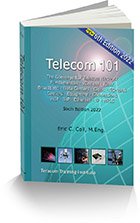
In addition to the high-quality 419-page Course 110 course materials, you will also receive as a free bonus an electronic copy of our acclaimed textbook Telecom 101.
400 pages, 175 diagrams and 25 years of knowledge in one book, yours free.
claim your bonus
COURSE MATERIALS
Every course comes complete with high-quality 419-page course materials in a bound workbook / textbook that's been called the best on-the-job reference tool around.
Written in plain English, this easy-to-use reference includes copies of all graphics PLUS extensive detailed text.
Topics are organized in logical groups to give you easy reference after the seminar to the practical experience, theoretical background, and unbiased information on industry technologies, products and trends you'll need.
With numerous chapters covering all major topics, you'll obtain an invaluable resource impossible to find anywhere else in one book.
You can get a sneak preview of course materials via the tutorials.
WHO SHOULD ATTEND
Non-engineering professionals familiar with traditional telecom who need to establish a solid base in IP and VoIP technologies and services.
Newcomers to telecommunications who want to concentrate on new/future technologies instead of "the past".
Decision-makers and managers and anyone else who wants to understand what the "techies" are saying.
Anyone who wants to eliminate jargon- and buzzword-related frustration, understand IP network and VoIP concepts and how it all fits together.
Anyone willing to invest three days to obtain career-enhancing training, with certification and reference book.
PREREQUISITES
There are no prerequisites for this course. We expect students will be reasonably intelligent, have a desire to learn - and are starting from the beginning of the IP, VoIP and MPLS telecom story.
TUITION FEES
This high-quality, up-to-date course is value priced at only $1395 for the three days, including certification test, certificate and 419-page detailed course materials / reference book. Compare to $1999 and up for lower quality elsewhere.
HOW TO REGISTER
Register online with our convenient automated system, or call us anytime to speak with a live person.
THE COURSE DIRECTOR
Eric Coll
Eric Coll, M.Eng., P.Eng.
Eric Coll is an international expert in telecommunications, data communications and networking and has been actively involved in the industry since 1983. He holds Bachelor’s and Master of Engineering (Electrical) degrees, and is licensed as a Professional Engineer in his home jurisdiction.
Mr. Coll has taught telecommunications technology and data communications training seminars to wide acclaim across North America since 1992, and has broad experience working as an engineer in the telecommunications industry.
He has worked for Nortel's R&D labs as a design engineer on projects including digital voice and data communications research and digital network equipment design; on satellite radar systems; Wide Area Network design for HMO applications; and many other projects in capacities ranging from detailed design and implementation to systems engineering, project leader and consultant.
Students consistently rate Eric excellent on course evaluations and specifically praise his broad and deep knowledge, his use of analogies to get ideas across, and his well-developed sense of humor.
COURSE INSTRUCTORS
Jay McGuire
Jay McGuire, M.Eng.
Jay D. McGuire holds advanced degrees in engineering and has been a professional trainer since 1982.
Jay specializes in delivering instructor-led technical training covering the fields of telecommunications, data communications and networking, local area networks, and call center and customer care technologies.
His publications and training manuals use a highly graphical approach to teaching technical concepts to non-technical audiences from a wide range of corporate environments.
Jay has held past positions as a telecommunications manager for a Fortune 100 insurance company and as a digital design engineer.
He is "one of the best" in the technical training business.
Richard Olsen
Richard Olsen, B.S.E.E., P.E.
Richard Olsen holds a B.S. in Electrical Engineering and has over 36 years of professional engineering and teaching experience.
Richard held senior management and engineering positions at Southwestern Bell for over 20 years. He has served as an instructor for numerous major companies as well as being an Adjunct Professor and Executive-in-Residence in the Master of Science in Telecommunications Management degree program, Oklahoma State University.
Richard is a member of the MSTM Industry Advisory Board, Oklahoma State University, the National Society of Professional Engineers, the Oklahoma Society of Professional Engineers and the IEEE.

Richard consistently receives excellent ratings across the board on student evaluations, with many comments specifically praising his knowledge and thoroughness in making sure everyone understands the topics.

 
all brochures   seminars   DVD-video   reference books   elearning   CBT   tutorials   private onsite classes   free previews   
 3.3.2
Copyright © Teracom Training Institute.   All rights reserved.    privacy policy