go to Teracom home page  
 Course 101: Telecom,Datacom and Networking for Non-Engineers (3 days)
Full brochure Schedule Register Video version More courses Print this page
Description
Telecom, Datacom and Networking for Non-Engineers is Teracom's "core training" - an intensive three-day course designed for non-engineering professionals, covering virtually all aspects of telecom, datacom and networking. 
Our emphasis is on busting the buzzwords, explaining the jargon, and most importantly, explaining the ideas behind the jargon: key concept-level knowledge you can't get reading trade magazines or talking to vendors. 
We start at the beginning of the story, progress through it in a logical order, and finish at the end.  Progressing through the topics in this systematic way, we build structured knowledge that lasts a lifetime. 
Course Organization
Telecom, Datacom and Networking for Non-Engineers is presented as three one-day modules:
Module 1 (Day 1): Fundamentals of Telecommunications
Module 2 (Day 2): Understanding Data Communications
Module 3 (Day 3): Understanding IP and Networking
Course Materials
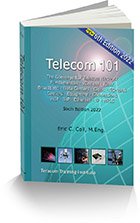
Each participant receives three high-quality workbooks (one for each day) with copies of all diagrams and extensive notes, sure to be a valuable reference for years to come.  An optional textbook Telecom 101 covering the same material, but organized for day-to-day reference after the initial training in standard softcover textbook format with an index and accompanying searchable electronic version is also available.
Prerequisites
None
 
Course Objectives
Fill in the gaps in your knowledge.
Establish a solid base in the fundamentals of telecom, datacom and networking.
Understand mainstream technologies, practices and solutions.
Put a structure in place that project-specific knowledge can be built on in the future.
Understand how it all fits together.
Develop career-enhancing knowledge skills.
Thousands have benefited
The content, its order, timing and pacing have been tuned and refined over the course of ten years. Thousands of people from companies and organizations ranging from Cisco, Intel, Qualcomm, Microsoft, the CIA, IRS, FAA and US Army to Oneida Tableware and the Portland Trailblazers have taken this course.
This core training - and our superb instructors - consistently receive rave reviews on seminar evaluations.  Many attendees tell us that this is knowledge that they have been needing for years.  Join us to benefit from this career-enhancing training!
Who should attend
Project leaders responsible for handling specification and implementation of communication and network projects.
Non-technical personnel needing to converse with "techies".
Management, administration and finance personnel wanting to eliminate jargon and buzzword frustration.
Non-engineering personnel from LECs, CLECs, IXCs: analysts, managers, marketing and sales personnel needing to build a structural knowledge of technologies, services, equipment and mainstream solutions.
Those new to the business needing to get up to speed.
Personnel from hardware and infrastructure manufacturers needing to see how their products fit into the bigger picture.
IS/IT professionals requiring an overview of telecom, datacom and IP networking technologies, services, mainstream solutions and trends.
Decision makers seeking a big picture perspective on telecommunications networks and services
 - in plain English.

 Course 101 Telecom, Datacom and Networking for Non-Engineers  
 Module 1: Fundamentals of Telecommunications (Day 1)
Description
The first module covers the Public Switched Telephone Network, equipment and call centers, the telecom business, carriers, digital voice transmission, T1, fiber and SONET backbones, and wireless . the groundwork for understanding everything.
Module Objectives
Understand telecom fundamentals: telephony and the Public Switched Telephone Network, the telecom business, digital transmission systems and wireless.

Fill in knowledge gaps to form a solid base on which to build.

What you will learn
The structure and operation of the telephone network
What analog means.  The voiceband.  Loops and trunks.
Plain Ordinary Telephone Service.
What CO switches, PBXs, IVRs, ACDs and modems do.
All about LECs, CLECs, IXCs and interconnections.
What digital means.  What a DS0 is.
The difference between a DS1 and a T1.
DS3, T3, SONET, and ISDN.  Time-Division Multiplexing.
What fiber is and how backbones are built with fiber.
Wireless and cellular concepts, terminology, standards.
Prerequisites
None
Who should attend
Those needing to fill in the gaps and put in place a solid base of fundamentals.  No matter what you want to understand, you have to start with Plain Ordinary Telephone Service and the PSTN.  Most all technologies, including data circuits used for the Internet, can be traced back to these first principles.
 
Module Outline (Summary):
The Public Switched Telephone Network
Loops and trunks, twisted pair; COs, and remotes
Analog and the voiceband; POTS; SS7 overview
Telecom Equipment
Switches, PBXs, IVRs, ACDs, call centers
Overview of modems and DSL
The Telecommunications Industry
LECs, IXCs, CLECs, interconnections
Alliances, mergers, current developments
Digital Transmission
Digital voice, video and data; DS0, DS1, DS3
Transmission Systems
TDM concepts; T1, T3, ISDN; SONET, optical, DWDM
Introduction to Wireless
Overview of wireless: cellular, PCS, 3G, Wi-Fi, satellite

 Course 101 Telecom, Datacom and Networking for Non-Engineers
 Module 2: Understanding Data Communications (Day 2)
Description
The second module covers datacom basics including the crucial concepts of IP packets and LAN frames; all about modems including DSL and cable modems, data over digital cellular, how digital circuits and services are provided, muxes vs. switches vs. routers, and finishes with LANs: building blocks for the Networking module.
Module Objectives
Understand datacom fundamentals: the components of a circuit, how data is organized for transmission, how data is actually moved from A to B.

Get the big-picture view; see how carrier circuits are actually provided, so you can understand and compare different services.

What you will learn
DTEs, DCEs, media, and how they form a circuit.
Common configurations: parallel, serial, multidrop, multipoint,
LANs and WANs.
An overview of binary and hex.
Asynchronous: ASCII and start/stop/parity.
Newer ideas: frames and packets.  IP packets.
All about modems, modulation, concepts and standards.
DSL vs. Cable: which is faster?  Cable TV systems.
Network equipment: switches vs. muxes vs. routers.
All about LANs: Ethernet, cable categories, switches.
Prerequisites
None.  Module 1, Fundamentals of Telecom is beneficial, as it explains the concepts underlying circuits for modems and digital data.
Who should attend
Those needing to fill in the gaps and put in place a solid base of fundamentals of datacom.  This core knowledge sets the stage for understanding networking, routers, the Internet and the wireless web.
Module Outline (Summary):
Datacom Basics
Datacom basics: DTEs, DCEs, LANs and WANs
How Data is Formatted for Transmission
IP packets, LAN frames; ASCII, binary and hex
All About Modems
How modems work; standards, buzzwords, issues
Broadband Modems
High-capacity modems: DSL, Cable, 3G wireless
Data Services and Network Equipment
Dedicated lines vs. dial-up vs. bandwidth-on-demand
Multiplexers vs. switches vs. routers
LANs
All about LANs: Ethernet, cable categories, switches, routers

 Course 101 Telecom, Datacom and Networking for Non-Engineers

 Module 3: Understanding IP and Networking (Day 3)
Description
The third module brings it all together with a structured discussion of networking: protocol stacks, routers, IP addresses, bandwidth-on-demand services, Voice over IP (VoIP) and IP VPNs, the Internet, and finishes with a top-down review and templates for mainstream solutions you can put to immediate use.
Module Objectives
Understand networking fundamentals as well as current practical technologies, services and solutions.

Understand protocol stacks and OSI, IP addresses, routers, carrier services and Internet structure and operation.

Understand carrier packet network services
Gain an overview of Voice over IP and how VoIP connects to the PSTN.
Understand Internet structure and operation.
Learn technology deployment steps.
What you will learn
Truly understand the OSI layers and protocol stacks.
Routers, IP address classes, DHCP, private addresses
NAT for sharing network connections
Private networks and dealing with carriers.
Bandwidth-on-demand and Virtual Circuit concepts.
How TCP and IP are used with Frame Relay.
MPLS as the replacement for Frame Relay.
The need for QoS. Implementing QoS with MPLS.
The components of a Voice over IP (VoIP) system.
How VoIP connects to the PSTN.
What an IP VPN is.
The history, structure and operation of the Internet.
Internet issues like ISPs, MIME, domain names.
Practical mainstream solutions for networks.
Prerequisites
None.  Module 2, Understanding Data Communications is beneficial, as it explains the building blocks: packets and frames, digital circuits and LANs.
Who should attend
Those needing to understand how systems are connected: protocols and standards, IP, packets, routers, networking services and the Internet -- and how it all fits together.
Module Outline (Summary):
Protocol Stacks
OSI 7-layer model; examples; standards organizations

IP Addressing, Routers and Private Networks

WANs: routers, IP addressing, dynamic addresses and DHCP, private addresses, Network Address Translation
Dealing with carriers: troubleshooting

Bandwidth-On-Demand: Packet Network Services

Bandwidth on demand concepts; virtual circuits
Technologies: X.25, Frame Relay
MPLS and QoS for voice over packet networks

IP Network Services: Voice over IP (VoIP) and IP VPNs

Voice over IP (VoIP)
Internet Telephony vs. Managed-IP Telephony
Interconnecting VoIP and the PSTN
IP VPNs
The Internet
Internet past and present; ISPs
Internet protocols; TCP for reliability; router table updates
DNS, MIME, HTML and HTTP, browsers and servers
Wrapping Up
Technology deployment steps
Practical solutions
The IP-PSTN
Schedule and registration
Please visit teracomtraining.com to see the latest schedule and register online, or call us toll-free at 1-877-412-2700.
Tuition fees
$995 for US courses, C$995 for Canadian courses.
*It is possible to attend individual days of this three-day course. Please see the full brochure for details and pricing.
Full brochure Schedule Register Video version More courses Print this page