﻿<?xml version="1.0" encoding="utf-8"?>
<rss version="2.0" xmlns:atom="http://www.w3.org/2005/Atom" xmlns:cf="http://www.microsoft.com/schemas/rss/core/2005" xmlns:bc="http://www.brightcove.com/link" xmlns:media="http://search.yahoo.com/mrss/">
  <channel>
    <lastBuildDate>Thu, 13 Mar 2008 08:01:06 -0800</lastBuildDate>
    <title>Teracom Training Institute - Telecommunications Training - VoIP Training
 </title>
    <description>Telecommunications training and VoIP training seminars and courses for non-engineers: Telecom, datacom, IP, networking, voice over IP (VoIP), MPLS, SIP, wireless and much, much more.
 </description>
    <link>http://www.teracomtraining.com</link>
    <item>
      <title>Budget Year-End Special #1: Teracom DVD-Video Course Library - 40% off</title>
      <description>Nearing year-end? Money left in budgets? Seize the opportunity to benefit from Teracom's world-renowned training.
To make it even easier, we're putting on great specials until March 31.

Funds - in either departmental or project budgets - for training, employee development, productivity enhancement, team building, special projects, furnishings, office supplies and general expenses can all be legitimately used to make this invaluable, productivity-enhancing addition to your group's resources.

Teracom's Full DVD Library is an excellent choice for allocating budgeted funds at year-end, and an invaluable addition to your departmental training resources. 

Covering everything from POTS to CDMA, VoIP and MPLS, we
• bust the buzzwords,
• demystify jargon, 
• explain technologies, protocols and mainstream solutions, 
and most importantly:
• the underlying ideas and how it all works together... in plain English. 

Establishing this solid knowledge base increases productivity and improves efficiency, eliminating buzzword and bafflegab frustration. Join the thousands of organizations who have have benefited! Many people tell us they wish they'd had this training years ago.

Until March 31, the library of all nine Teracom DVD-video courses with nine course workbooks, is on sale for $997... a savings of more than 40%. 

Order DVD-video product # V540 either online with your credit card, or fax us a PO along with the printed order form, and get this world-renowned training today. Free domestic shipping!

You will receive the full library of NINE two-hour multimedia courses. Compare this $2000 for ONE course elsewhere, and you'll agree this is a very good deal. PLUS, our courses are up-to-date, authoritative, and packed with information. Add to this the high-quality student materials for each course, the exercises and certificate suitable for framing... details previews 

Your satisfaction is guaranteed. 
If for any reason you are dissatisfied, simply return the DVD courses for a refund. </description>
      <link>http://www.teracomtraining.com/newsletters/newsletter_2008-03.htm#special1</link>
      <pubDate>Thu, 13 Mar 2008 08:01:05 -0800</pubDate>
    </item>
    <item>
      <title>Budget Year-End Special #2: Telecom 101, new 3rd edition - $99 each for two or more </title>
      <description>Telecom 101 is the three course workbooks from our acclaimed core training Course 101 Telecom, Datacom and Networking for Non-Engineers combined together into a professionally-bound standard softcover textbook with 400 pages, 177 diagrams and a full index.

This invaluable reference book and day-to-day handbook covers telecom, datacom and networking from A-Z, organized in logical chapters covering all major topics, and written in our signature "telecom for non-engineers" style. 

This content, tuned and refined over the course of fifteen years, has been taught to thousands of people needing to build a solid, structured understanding of telecom, datacom and networking. A high percentage of seminar attendees specifically praise the course materials on evaluations – now available in textbook format more

Until March 31, it's on sale for $99 when you buy two or more copies, a savings of more than 40% off the regular price. 

Order textbook product # T102, either online with your credit card, or fax us a PO along with the printed order form, and get this world-renowned training today. 
</description>
      <link>http://www.teracomtraining.com/newsletters/newsletter_2008-03.htm#special2</link>
      <pubDate>Thu, 13 Mar 2008 08:01:04 -0800</pubDate>
    </item>
    <item>
      <title>Budget Year-End Special #3: BOTH!  Order the Full DVD Library and get ten (10) Telecom 101 reference books free</title>
      <description>Our best offer yet: get both the DVD library and Telecom 101 reference books! 
Order the Full DVD Library at the regular price and we will include a set of ten Telecom 101 reference books, for everyone in your group. This is in addition to the video course workbooks. 

Order DVD-video product # V550, either online with your credit card, or fax us a PO along with the printed order form, and get this world-renowned training today. 

Cinema-quality video, animated bullets, plenty of crisp graphics, navigation menus and more - Teracom DVDs are private high-quality multimedia lessons from the Director of the Institute! DVDs also mean guaranteed to play, convenient broadband and easy to pass around in your department. They are ideal to watch on your laptop during a flight. Connect to an LCD projector and you've got very high value-added group training for your people.

Satisfaction guaranteed or your money refunded. What have you got to lose? Act now before it's too late.</description>
      <link>http://www.teracomtraining.com/newsletters/newsletter_2008-03.htm#special3</link>
      <pubDate>Thu, 13 Mar 2008 08:01:03 -0800</pubDate>
    </item>
    <item>
      <title>Tutorial: Authentication, Digital Signatures and Digitally-Signed Email </title>
      <description>
Teracom’s Course 110 IP Telecom and VoIP for Non-Engineers is an intensive 3-day course covering virtually all aspects of IP networks, IP telephony and VoIP systems, designed for non-engineers who need to who need to get up to speed on the theory, demystify the jargon and buzzwords, understand the  technologies and most importantly, how it all fits together.

Independent of any particular vendor’s products, this course will put in place the solid foundation knowledge necessary to deal with IP telecom network projects and IP voice and data applications with confidence.  Mastering the buzzwords and jargon, understanding the technologies, protocols and core concepts – and how it all works together are productivity-enhancing skills you can build on.

Key Course Features:
- Solid coverage of IP telephony and VoIP systems
  • Packetized voice, codecs and voice quality
  • RTP/UDP/IP protocol stack
  • Softswitches, gateways, servers and other system components
  • SIP and call setup in the IP world 

- Solid coverage of IP networking and its components: OSI Layers 1 – 3
  • IP addressing, DHCP, NAT, subnetting and routing
  • LANs, MAC addresses, frames vs. packets, VLANs
  • Fiber, Optical Ethernet, DOCSIS, VDSL

- IP Security and QoS
  • Network segmentation, firewalls, IPsec and VPNs, encryption, authentication, VoIP security
  • MPLS and QoS: how MPLS implements Diff-Serv 

- Designed for non-engineers
  • Understand the jargon and buzzwords, technologies, protocols and standards, and most importantly, the underlying ideas and how it all works together – in plain English – without bogging down on detailed design discussions.

- Vendor independent
  • Core foundation knowledge that can be applied to any related project or system.

- Proven content 
  • This course was originally developed for a major telephone company and was used to train and upgrade the knowledge skills of 5,000 of their employees.
  • The course content and materials have subsequently been tuned, refined, improved and updated over a period of five years.

- Technically-qualified professional instructors
  • Our instructors hold Bachelor of Engineering degrees or equivalent and have decades of experience working in the field.  They consistently receive the highest ratings across the board and written praise on student evaluations.

- High-quality course materials 
  • Each student receives a 300-page high-quality bound student manual with copies of all diagrams plus detailed text notes, sure to be a valuable reference for years to come.  Totally up-to-date and bringing together all of this information, impossible to find in one place anywhere else.
Added bonus: each student also receives a downloadable copy of Teracom’s new textbook “Telecom 101”, 3rd edition 2008.  400 pages, over 175 diagrams, 25 years of knowledge in one book.

Course Content (Overview)
Parts 2, 3 and 4 are the main part of the course.  Part 1 is a high-level introduction covered relatively quickly.  The amount of time spent on Part 5 and the wrap-up is adjusted to meet the needs of the class.

Part 1: The Big Picture 
The first part of IP Telecommunications is the big-picture view. We’ll cover the strategic and business reasons for the all-IP telecommunications network, the IP telecom network architecture and IP telecom services. We’ll also get a start on VoIP, identifying the main VoIP components, architectures and applications.
- - Convergence and converged networks  
- Broadband IP dial tone as the replacement for POTS 	 
- Why we will stop thinking of “the telephone network” and “the IP data network” as different 
- The benefits, challenges and opportunities of an all-IP telecom network
- Network architecture: core, edge and access. Optical Ethernet and MANs. 
- Network services: categories of providers, IP network Service Level Agreements, applications
- Voice over IP, IP telephony and VoIP jargon, buzzwords, components and architectures. 

Part 2: Network Technologies 
Part 2 covers the network technologies that are the IP-PSTN, including fiber, Ethernet and all of the different aspects of IP. Encompassing six chapters, this Part includes both IP and LAN fundamentals to fill in gaps, plus selected important advanced topics like VLANs, CIDR subnet prefix + mask, routing protocols like OSPF and BGP, multicasting and IPv6. Without bogging down on details, we’ll take your knowledge of things IP to the next level… solid career-enhancing knowledge that lasts a lifetime.
- Fiber, VDSL and DOCSIS.  Optical Ethernet . 
- Why we use the term “broadcast domain” instead of “LAN” 
- How VLANs are used to compartmentalize devices 
- All about IP addressing: static, dynamic, public, private, DHCP, ARP, routing protocols 
- What an IP subnet and mask is, and how this is related to VLANs 
- How routing really works 
- TCP, UDP, ports, sockets, multicasting and other topics 

Part 3: VoIP and IP Telephony 
Part 3 is devoted to one of the main applications that will run over the network of Part 2: telephone service. This part covers the nuts and bolts of Voice over IP: packetized voice, SIP and call flow, protocol stacks, softswitches and gateways, codecs and compression, PBX replacement and carrier interconnect. 
- What exactly packetized voice is, how it happens and the standards and protocols used
- RTP and correcting for jitter, delay and lost packets
- Codecs and voice compression: G.711, G.722, G.729 
- All about SIP and call flow in the IP world
- Carrier interconnect: connecting at the IP level, SBCs, Megaco and DS0 interconnect 

Part 4: IP Security and Quality of Service
This Part covers the essential topic of IP security, including firewalls, encryption and authentication, IP VPNs, viruses and Trojans, plus QoS and how Service Level Agreements are implemented on a carrier’s IP network including MPLS and Diff-Serv. 
- The tools and techniques for controlling traffic and implementing service levels in the IP world
- Understand how MPLS implements Diff-Serv to implement QoS and SLAs
- Get a comprehensive overview of security in the IP world
- Learn the critical concept of network segmentation, assigning IP subnets to VLANs
- Understand what L2/L3 routing switches like Nortel Passports and Cisco Catalysts do - and why 
- Firewall technologies: packet filtering, application, SPI 
- IPsec for encryption and authentication, used to implement VPNs 
- The threat of malicious software such as Trojan horses
- Special threats against a VoIP telephone system

Part 5: The Practical 
The fifth part of the course adds value with a series of practical discussions related to VoIP implementation, identifying issues that must be understood and addressed, mainstream solutions and vendor profiles. 
- VOIP READINESS ASSESSMENT Step-by-step, we’ll walk through issues that must be considered, resolved and checked off when planning a migration to VoIP, and finish with a practical Readiness Assessment Checklist you can put to immediate use. This will allow you to plan for change, rather than having hidden issues become a series of career-limiting surprises. 
- In-building deployment options / case studies: PBX vs. softswitch vs. IP Centrex / hosted PBX 
- WAN deployment options / case studies: private network, data network, Internet, VPN 
- VoIP vendor profiles: hardware, software, softswitch vendors 

We'll wrap things up with a high-level view towards the future, what we consider to be the truly “neat” applications and where we are headed with converged IP-based communications: web-enabled multimedia call centers, unified messaging, presence, intelligent call handling and location independence. 

Register today to benefit from this career-enhancing knowledge upgrade!
http://www.teracomtraining.com
</description>
      <link>http://www.teracomtraining.com/newsletters/newsletter_2008-03.htm#tutorial</link>
      <pubDate>Thu, 13 Mar 2008 08:01:02 -0800</pubDate>
    </item>
    <item>
      <title>COURSE 110  IP TELECOM and VOIP FOR NON-ENGINEERS</title>
      <description>
Teracom’s Course 110 IP Telecom and VoIP for Non-Engineers is an intensive 3-day course covering virtually all aspects of IP networks, IP telephony and VoIP systems, designed for non-engineers who need to who need to get up to speed on the theory, demystify the jargon and buzzwords, understand the  technologies and most importantly, how it all fits together.

Independent of any particular vendor’s products, this course will put in place the solid foundation knowledge necessary to deal with IP telecom network projects and IP voice and data applications with confidence.  Mastering the buzzwords and jargon, understanding the technologies, protocols and core concepts – and how it all works together are productivity-enhancing skills you can build on.

Key Course Features:
- Solid coverage of IP telephony and VoIP systems
  • Packetized voice, codecs and voice quality
  • RTP/UDP/IP protocol stack
  • Softswitches, gateways, servers and other system components
  • SIP and call setup in the IP world 

- Solid coverage of IP networking and its components: OSI Layers 1 – 3
  • IP addressing, DHCP, NAT, subnetting and routing
  • LANs, MAC addresses, frames vs. packets, VLANs
  • Fiber, Optical Ethernet, DOCSIS, VDSL

- IP Security and QoS
  • Network segmentation, firewalls, IPsec and VPNs, encryption, authentication, VoIP security
  • MPLS and QoS: how MPLS implements Diff-Serv 

- Designed for non-engineers
  • Understand the jargon and buzzwords, technologies, protocols and standards, and most importantly, the underlying ideas and how it all works together – in plain English – without bogging down on detailed design discussions.

- Vendor independent
  • Core foundation knowledge that can be applied to any related project or system.

- Proven content 
  • This course was originally developed for a major telephone company and was used to train and upgrade the knowledge skills of 5,000 of their employees.
  • The course content and materials have subsequently been tuned, refined, improved and updated over a period of five years.

- Technically-qualified professional instructors
  • Our instructors hold Bachelor of Engineering degrees or equivalent and have decades of experience working in the field.  They consistently receive the highest ratings across the board and written praise on student evaluations.

- High-quality course materials 
  • Each student receives a 300-page high-quality bound student manual with copies of all diagrams plus detailed text notes, sure to be a valuable reference for years to come.  Totally up-to-date and bringing together all of this information, impossible to find in one place anywhere else.
Added bonus: each student also receives a downloadable copy of Teracom’s new textbook “Telecom 101”, 3rd edition 2008.  400 pages, over 175 diagrams, 25 years of knowledge in one book.

Course Content (Overview)
Parts 2, 3 and 4 are the main part of the course.  Part 1 is a high-level introduction covered relatively quickly.  The amount of time spent on Part 5 and the wrap-up is adjusted to meet the needs of the class.

Part 1: The Big Picture 
The first part of IP Telecommunications is the big-picture view. We’ll cover the strategic and business reasons for the all-IP telecommunications network, the IP telecom network architecture and IP telecom services. We’ll also get a start on VoIP, identifying the main VoIP components, architectures and applications.
- - Convergence and converged networks  
- Broadband IP dial tone as the replacement for POTS 	 
- Why we will stop thinking of “the telephone network” and “the IP data network” as different 
- The benefits, challenges and opportunities of an all-IP telecom network
- Network architecture: core, edge and access. Optical Ethernet and MANs. 
- Network services: categories of providers, IP network Service Level Agreements, applications
- Voice over IP, IP telephony and VoIP jargon, buzzwords, components and architectures. 

Part 2: Network Technologies 
Part 2 covers the network technologies that are the IP-PSTN, including fiber, Ethernet and all of the different aspects of IP. Encompassing six chapters, this Part includes both IP and LAN fundamentals to fill in gaps, plus selected important advanced topics like VLANs, CIDR subnet prefix + mask, routing protocols like OSPF and BGP, multicasting and IPv6. Without bogging down on details, we’ll take your knowledge of things IP to the next level… solid career-enhancing knowledge that lasts a lifetime.
- Fiber, VDSL and DOCSIS.  Optical Ethernet . 
- Why we use the term “broadcast domain” instead of “LAN” 
- How VLANs are used to compartmentalize devices 
- All about IP addressing: static, dynamic, public, private, DHCP, ARP, routing protocols 
- What an IP subnet and mask is, and how this is related to VLANs 
- How routing really works 
- TCP, UDP, ports, sockets, multicasting and other topics 

Part 3: VoIP and IP Telephony 
Part 3 is devoted to one of the main applications that will run over the network of Part 2: telephone service. This part covers the nuts and bolts of Voice over IP: packetized voice, SIP and call flow, protocol stacks, softswitches and gateways, codecs and compression, PBX replacement and carrier interconnect. 
- What exactly packetized voice is, how it happens and the standards and protocols used
- RTP and correcting for jitter, delay and lost packets
- Codecs and voice compression: G.711, G.722, G.729 
- All about SIP and call flow in the IP world
- Carrier interconnect: connecting at the IP level, SBCs, Megaco and DS0 interconnect 

Part 4: IP Security and Quality of Service
This Part covers the essential topic of IP security, including firewalls, encryption and authentication, IP VPNs, viruses and Trojans, plus QoS and how Service Level Agreements are implemented on a carrier’s IP network including MPLS and Diff-Serv. 
- The tools and techniques for controlling traffic and implementing service levels in the IP world
- Understand how MPLS implements Diff-Serv to implement QoS and SLAs
- Get a comprehensive overview of security in the IP world
- Learn the critical concept of network segmentation, assigning IP subnets to VLANs
- Understand what L2/L3 routing switches like Nortel Passports and Cisco Catalysts do - and why 
- Firewall technologies: packet filtering, application, SPI 
- IPsec for encryption and authentication, used to implement VPNs 
- The threat of malicious software such as Trojan horses
- Special threats against a VoIP telephone system

Part 5: The Practical 
The fifth part of the course adds value with a series of practical discussions related to VoIP implementation, identifying issues that must be understood and addressed, mainstream solutions and vendor profiles. 
- VOIP READINESS ASSESSMENT Step-by-step, we’ll walk through issues that must be considered, resolved and checked off when planning a migration to VoIP, and finish with a practical Readiness Assessment Checklist you can put to immediate use. This will allow you to plan for change, rather than having hidden issues become a series of career-limiting surprises. 
- In-building deployment options / case studies: PBX vs. softswitch vs. IP Centrex / hosted PBX 
- WAN deployment options / case studies: private network, data network, Internet, VPN 
- VoIP vendor profiles: hardware, software, softswitch vendors 

We'll wrap things up with a high-level view towards the future, what we consider to be the truly “neat” applications and where we are headed with converged IP-based communications: web-enabled multimedia call centers, unified messaging, presence, intelligent call handling and location independence. 

Register today to benefit from this career-enhancing knowledge upgrade!
http://www.teracomtraining.com
</description>
      <link>http://www.teracomtraining.com/courses/110/ip-telecom-VoIP-training.htm</link>
      <pubDate>Thu, 19 Feb 2008 08:01:05 -0800</pubDate>
    </item>
    <item>
      <title>Tutorial: The IP-PSTN</title>
      <description>1.03 The Packet-Switched Telecommunications Network Over the past fifty years, several attempts have been made to develop converged networks: networks with “dial tone” that supports all communications: speech, music, text, graphics, images and video. For a number of reasons, convergence strategies employing ISDN and ATM were unsuccessful and did not gain critical mass. This time, it appears that packet-switched network service using IP will gain enough momentum to become the new kind of plain ordinary telecommunications service.

Beginning with grunts and gestures, progressing to verbal messages, signal fires, written messages, postal services, telegraphy, radio, telephone, television and computer networks, each advance in technology has meant communication of more information, faster and to more people – but often with the need to adapt the information to suit the communication technology being used. Realization of a converged network will be another step in the evolution of the way humans communicate, in that communication mechanisms best suited to the information will be used, rather than the other way around. 

(click to read the rest, with image)</description>
      <link>https://www.teracomtraining.com/newsletters/newsletter_2008-01.htm</link>
      <pubDate>Thu, 3 Jan 2008 08:01:05 -0800</pubDate>
    </item>
    <item>
      <title>Tutorial: TCP/IP over MPLS</title>
      <description>a section from the new edition of Telecom 101, tracing the flow of information from server to client over a TCP/IP/MPLS protocol stack. 
  
18.8 TCP/IP Over MPLS 
MPLS is deployed for managing traffic on IP networks, and in conjunction with other technologies like VPNs covered in Chapter 19, will end up replacing all other services, including dedicated T1s, Frame Relay, ATM and ISDN.

Since MPLS is a virtual circuit technology, the packet flow from server to client over an MPLS network is similar to the Frame Relay flow examined earlier.

Starting with the server on the right... (click link to see the rest)
 
 
</description>
      <link>https://www.teracomtraining.com/newsletters/newsletter_2007-12.htm#tutorial</link>
      <pubDate>Fri, 21 Dec 2007 08:01:06 -0800</pubDate>
    </item>
    <item>
      <title>BOOT CAMP ... 30% discount </title>
      <description>5-DAY BOOT CAMP  
Really get up to speed - and save 30% 
 
BOOT CAMP is two courses back-to-back in one intensive week: 
Telecom, Datacom and Networking for Non-Engineers (Course 101) 
and Understanding Voice over IP (Course 130).  
You get a 30% discount on both courses.  
 
Washington DC area  January 28-29-30-31-Feb 1 
Santa Clara, CA  February 4-5-6-7-8  
Chicago IL  April 7-8-9-10-11  
New York City area  May 5-6-7-8-9  
 
Seize this opportunity to really get up to speed and fill in the gaps. 
You'll have an advantage over the competition with this career-enhancing knowledge 
of telecom, datacom, networking and VoIP. You'll be a lot more effective and a lot less frustrated, 
understanding the ensemble of communications technologies, the jargon, buzzwords 
and how it all works together.   
 
This is an easy sell with management.
Your increased efficiency, productivity and informed decision-making will repay the cost of the training many times over.  

This is a no-brainer cost-wise.
If you were planning to take Course 101, you're adding two days of VoIP training for only $260!
Registering for Course 130? Get our acclaimed 3-day core training course for only $460.  
Attending both courses as the 5-day BOOT CAMP is totally optional. 
You are welcome to attend one course, or the other, or both, as best meets your needs.
But with the low incremental cost and wall-to-wall training, the 5-day Boot Camp is a great opportunity. 
Recent Boot Camps in Washington and Chicago were very well received. </description>
      <link>http://www.teracomtraining.com/boot-camp.htm</link>
      <pubDate>Fri, 21 Dec 2007 08:01:07 -0800</pubDate>
    </item>
    <item>
      <title>TELECOM 101 telecom book - THIRD EDITION 2008 TOTALLY UPDATED</title>
      <description>Telecom 101 Textbook 
 
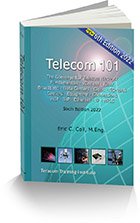
Telecom 101 is the three course workbooks from our acclaimed core training Course 101 Telecom, Datacom and Networking for Non-Engineers combined together into a single professionally-bound softcover textbook with a laminated cover, 400 pages, 177 diagrams and a full index. 

Organized in logical chapters covering all major topics, packed with information, authoritative and up to date, this telecom book is an invaluable study guide and day-to-day reference.

Free bonus!
electronic version 
 
Specifically Designed for Non-Engineers 
We'll bust buzzwords, demystify jargon, and cut through doubletalk. You'll fill in gaps, build a solid, structured base of knowledge and learn how everything fits together... knowledge and understanding that lasts a lifetime.  
 
Tested, Refined and Proven Content 
Combining three workbooks formatted into a standard 7” x 9” softcover textbook with high-quality paper, a laminated cover and professional binding, 400 pages, over 177 diagrams and a full index, the Telecom 101 volume has three parts:  
 • Fundamentals of Telecommunications, 
 • Understanding Data Communications and 
 • Understanding IP and Networking,  
with the same content as the course workbooks for our three-day core training Course 101 Telecom, Datacom and Networking for Non-Engineers, plus additional bonus sections. 
This content, tuned and refined over the course of fifteen years, has been taught to thousands of people needing to build a solid, structured understanding of telecom, datacom, IP and networking.  
A high percentage of seminar attendees specifically praise the course materials on seminar evaluations – materials now available in softcover textbook format in Telecom 101. 
 
An Invaluable Reference 
The material covers telecom, datacom and networking from A-Z, organized in logical chapters covering all major topics, and written in our signature "telecom for non-engineers"Glance  
Written by our top instructor, Eric C. Coll, M.Eng., P.Eng, Telecom 101 contain 25 years of knowledge and learning distilled and organized into an invaluable study guide and practical day-to-day reference for non-engineers. 

Part 1: Fundamentals of Telecommunications
Introduction, the Three Answers, telecom services, telecom networks
Telephony, loops and trunks, the PSTN, POTS, analog, voiceband, SS7 
PBX and Centrex, IVRs, ACDs, call centers, modems, DSL
Telecom industry, LECs, CLECs, IXCs, POPs
Digital: DS0, DS1, DS3, T1, ISDN 
TDM, the network "cloud", network equipment, fiber, SONET, DWDM
T1, channels, framing, pulses and repeaters, muxes and cross-connects
Wireless: cellular, CDMA, TDMA/GSM, 3G 1X andamp; UMTS, satellite, Wi-Fi, WiMAX
Voice services and jargon 

Part 2: Understanding Data Communications
Datacom basics: DTEs, DCEs, LANs and WANs
Packets and frames, IP packets, Ethernet frames 
Modems: modulation techniques, standards, performance 
Broadband modems: DSL, VDSL, cable modems, broadband wireless
LANs: broadcast domains, 802.3 andamp; Ethernet, cables, LAN switches 

Part 3: Understanding IP and Networking
OSI model, layers, protocol stacks, standards 
IP addresses: static/dynamic, public/private, NAT, IPv4 and IPv6 
WANs, routers, edge routers, statistical TDM, dealing with carriers 
Bandwidth on demand, packet networks, virtual circuits
Frame Relay, Quality of Service (QoS), ATM, MPLS and TCP/IP over MPLS
Voice over IP and VPNs 
The Internet: ISPs, DNS, HTML, the Web
Practical networking solutions
 
Ideal for anyone needing an authoritative, up-to-date reference covering all major topics in telecommunications, data communications, IP and networking… in plain English. A wealth of clear, concise, organized knowledge, impossible to find in one place anywhere else!  
</description>
      <link>https://www.teracomtraining.com/textbooks.htm</link>
      <pubDate>Fri, 21 Dec 2007 08:01:09 -0800</pubDate>
    </item>
    <item>
      <title>Course schedule through June 2008 </title>
      <description>Schedule listings for courses in 2008 are now posted.</description>
      <link>http://www.teracomtraining.com/public_seminars.htm</link>
      <pubDate>Fri, 21 Dec 2007 08:01:08 -0800</pubDate>
    </item>
    <item>
      <title>Teracom DVD Video Courses</title>
      <description>High-quality DVD video training courses - like private lessons from the Director of the Institute!  Get up to speed and fill the gaps on telecom, datacom, networking, IP, MPLS, VoIP and wireless at your own pace. Teracom's courses are high-quality multimedia productions on DVD featuring the instructor, extensive animated graphics and point-by-point bullets. Our top instructor Eric Coll talks to you directly via the camera, using his vast experience and acclaimed ability to explain key concepts, mainstream technologies and how it all fits together - in plain English. Our goal is to bust the buzzwords, explain the jargon and instill structured understanding - knowledge that lasts a lifetime. Plus, every course comes with a comprehensive workbook with copies of all graphics and detailed reference notes, sure to be a valuable reference for years to come.  
</description>
      <link>http://www.teracomtraining.com/video_courses.htm?20070426-080008</link>
      <pubDate>Thu, 26 Apr 2007 08:00:08 -0800</pubDate>
    </item>
    <item>
      <title>VoIP Training - Voice over IP Courses on DVD-video / CBT</title>
      <description>Teracom's Understanding VoIP is a comprehensive set of multimedia video courses on DVD designed for those needing to get up to speed on and understand Voice over IP technologies, buzzwords, jargon and mainstream solutions, and importantly, the ideas and fundamental concepts underlying VoIP, independent of any particular vendor's viewpoint… knowledge you can't get reading trade magazines or talking to salespeople. 

Completely new second edition released March 2007, covering all major topics including SIP, Hosted PBX, RTP, codecs, MPLS, Diff-Serv and much more.

Featuring detailed graphics, bullets, extensive text notes and our engaging and often humorous instructor Eric Coll, M.Eng., P.Eng., these training courses will give you the solid foundation you need to intelligently discuss, compare, evaluate and understand VoIP technologies, products and implementations. </description>
      <link>http://www.teracomtraining.com/voip-training-courses-on-DVD-video.htm?20070426-080007</link>
      <pubDate>Thu, 26 Apr 2007 08:00:07 -0800</pubDate>
    </item>
    <item>
      <title>A very high value-added scenario for your organization</title>
      <description>CLASSROOM-STYLE TRAINING, in-house, at a fraction of the cost.  DVDs also play in DVD players - connect it to your LCD projector and you've got a very high value-added scenario for your organization. We'll bundle books and certificates for everyone at a reasonable price. </description>
      <link>http://www.teracomtraining.com/video_courses.htm?20070426-080006</link>
      <pubDate>Thu, 26 Apr 2007 08:00:06 -0800</pubDate>
    </item>
    <item>
      <title> 
Teracom selected as Tektronix Certified Training Partner
</title>
      <description> 
We're pleased to announce that Teracom Training Institute has been selected by Tektronix's Minacom service level assurance and VoIP testing division as a Certified Training Partner. This designation recognizes Teracom's quality training and relevance in providing training on fundamentals and infrastructure to complement Tektronix's service level assurance products. To mark the occasion, we are giving away a free Tektronix VoIP Measurements and Thresholds Reference Chart, designed to help operations personnel, support engineers, network technicians, and sales and marketing staff to fully understand the diverse measurements used to benchmark, monitor, assure and troubleshoot VoIP services. Presented in a concise, easy-to-read format, this chart is a valuable reference for understanding and managing the complexities of VoIP service quality. There is much more to measuring VoIP quality than Mean Opinion Score (MOS)! Callers expect quick connection after dialing, distortion and echo-free calls, adequate call volume, and functional fax service. This chart summarizes 48 metrics commonly used for speech and call quality, connectivity performance, Internet/data transmission, fax and carrier trunk testing, along with standard industry abbreviations, measurement ranges, units used, and common severity levels (Critical, Major, Minor, Warning, Excellent) used by operators for fault management and service monitoring. What do all these measurements mean? How are they calculated? The other side of the chart explains service quality metrics in detail, along with applicable standards, and how they are measured. A special section provides an overview of MOS, comparing common MOS algorithms and outlining their use in standard testing applications.
</description>
      <link> 
http://www.teracomtraining.com/ref/voip-service-quality-metrics-and-thresholds.pdf
</link>
      <pubDate>Thu, 26 Apr 2007 08:00:05 -0800</pubDate>
    </item>
    <item>
      <title>Course 101, Telecom, Datacom and Networking for Non-Engineers 
 </title>
      <description>
An intensive training course designed for non-engineering professionals, covering virtually all aspects of telecommunications, datacom, IP and networking, from fundamentals and jargon to the latest technologies. Our most popular course, referred to in-house as our core training. Provides a solid grounding in everything telecom, datacom and networking.
</description>
      <link>http://www.teracomtraining.com/courses/101/telecommunications-training.htm?20070426-080004</link>
      <pubDate>Thu, 26 Apr 2007 08:00:04 -0800</pubDate>
    </item>
    <item>
      <title>Course 110, IP Telecommunications: VoIP and the All-IP Network 
 </title>
      <description>
An intensive course covering virtually all aspects of IP telecom and IP networking, designed for professionals involved with telecom who need to learn to "speak IP". The next course in the core training series. Focuses on IP and VoIP. Popular with telecom people and newcomers to the business who have to get up to speed on and really understand IP and VoIP.
</description>
      <link>http://www.teracomtraining.com/courses/110/ip-telecom-VoIP-training.htm?20070426-080003 </link>
      <pubDate>Thu, 26 Apr 2007 08:00:03 -0800</pubDate>
    </item>
    <item>
      <title>Course 130, Understanding Voice over IP 
 </title>
      <description>
Geared for non-technical professionals needing to understand VoIP - jargon and buzzwords, concepts and components, protocols, technologies and architecture choices, why an organization would implement VoIP and how to go about doing it. VoIP for managers and administrators. More on VoIP and SIP applications and less on IP than Course 110. Includes the VoIP project management template. 
 </description>
      <link>http://www.teracomtraining.com/courses/301/voip-training.htm?20070426-080002</link>
      <pubDate>Thu, 26 Apr 2007 08:00:02 -0800</pubDate>
    </item>
    <item>
      <title>Course 150, IP Call Center Technology 
 </title>
      <description>
Get up to speed on IP in the call center with a complete, unbiased picture and a thorough understanding of the technologies, benefits, issues, migration and integration strategies, vendors and practical templates you can put to immediate use. Amazingly comprehensive. Essential for anyone upgrading a contact center to a VoIP system, or embarking on IM, chat or anything else IP in the contact center.
 </description>
      <link>http://www.teracomtraining.com/courses/150/ip-call-center-technology.htm?20070426-080001</link>
      <pubDate>Thu, 26 Apr 2007 08:00:01 -0800</pubDate>
    </item>
    <item>
      <title>Course 120, Understanding Wireless 
 </title>
      <description>
Designed for those needing to get up to speed, fill in the gaps and put in place a solid understanding of today's wireless technologies: Wi-LAN, cellular, 3G, 1XEV-DO, wireless web. Wireless access technologies: 802.11 wireless LAN + cellular from analog to 1XEV-DO 3G and wireless web. 
 </description>
      <link>http://www.teracomtraining.com/courses/120/wireless-training.htm?20070426-080000</link>
      <pubDate>Thu, 26 Apr 2007 08:00:00 -0800</pubDate>
    </item>
    <item>
      <title>Continuing Professional Education (CPE) Credits</title>
      <description>oks are "self-study", the student may be required to pass an exam to qualify for CPE credits. Teracom has exams.  
2. The CPE credits for contact hours are calculated by actual face time for instructor-led training, and by average completion time based on a sample of at least three students for self-study. 
3. A particular state association may not accept Teracom's courses for CPE credit. 
4. If in the unlikely event that documentation, justification or other work is required to support a claim for CPE credits for Teracom's courses for a particular state association, or to be accredited by a particular state association, that work is the responsibility of the student. Teracom's tuition fees do not include a component for such work.  
5. Teracom will provide a letter containing the following information to students who have purchased and completed our training. Contact us to request a letter. 
• CPE provider name and address
• Participant’s name
1. • Course title
2. • Course field of study
3. • Date offered or completed
4. • If applicable, location
5. • Type of instructional/delivery method used
6. • Amount of CPE credit awarded
7. • Description of computation used to determine amount of CPE credit awarded
8. • Verification by CPE provider representative.  
  
</description>
      <link>http://www.teracomtraining.com/cpe.htm</link>
      <pubDate>Mon, 18 Sep 2007 08:00:06 -0800</pubDate>
    </item>
  </channel>
  <channel>
    <lastBuildDate>Thu, 3 Jan 2008 08:01:06 -0800</lastBuildDate>
    <title>Video
 </title>
    <description>Telecommunications training and VoIP training video courses: Telecom, datacom, IP, networking, voice over IP (VoIP), wireless, MPLS and much, much more.</description>
    <link>http://www.teracomtraining.com/video_courses.htm</link>
    <item>
      <title>Teracom DVD Video Course V1: Fundamentals of Telecom 1 </title>
      <description>The PSTN - Telephony - The Telecom Industry - Telecom Equipment
The PSTN - Telephony - The Telecom Industry - Telecom Equipment

Length 142 minutes. 55-page 8.5" x 11" softcover bound student manual.
ISBN 1-894887-26-3. Produced 2006.

It all starts with the PSTN and POTS. We’ll begin with the basics of telephony: loops, trunks, circuits, analog, the voiceband… fundamentals that are key to understanding newer technologies and services. Then, we'll review switches, PBXs, Centrex and ancillary equipment like ACDs and IVRs. With this framework in place, we'll explore the telecommunications industry, understanding the main players and competitors, how LECs connect to IXCs, the switching hierarchy and how CLECs fit into the picture.

The topics in this course - how the telephone system and industry work, provide the essential foundation on which everything else, including digital communications, data circuits and networking are built.

http://www.teracomtraining.com/video_courses.htm
http://teracomtraining.net/previews/TERACOM_V1-preview.wmv
http://teracomtraining.net/previews/TERACOM-VIDEOTUTORIAL_V1-loops.wmv 
http://video.google.com/videoplay?docid=8327067700821353864andamp;q=telecommunications+training 
</description>
      <link>http://teracomtraining.net/previews/TERACOM_V1-preview.wmv </link>
      <pubDate>Wed, 25 Apr 2007 08:00:09 -0800</pubDate>
    </item>
    <item>
      <title>Teracom DVD Video Course V2: Fundamentals of Telecom 2 </title>
      <description>Voice Digitization - DS0-DS3 - Digitial Transmission and TDM 
T1 - T3 - ISDN - SONET - Fiber and DWDM 

Length 124 minutes. 63-page 8.5" x 11" softcover bound student manual.
ISBN 1-894887-29-8. Produced 2006.

In this course, we understand the concepts, standards and technologies for transmitting voice calls using traditional techniques. We'll give you a real understanding of what "digital" actually means and how it is implemented. You'll understand DS0 and the digital hierarchy and take a practical tour of digital circuits including T1, T3, SONET and ISDN. At a high level, we'll see how voice, data and video can be integrated via TDM and channelization. Then we'll take a closer look at how this is actually done, with multiplexers, pulses and repeaters, copper, fiber optics, fiber rings and WDM. 

Most of the transmission systems we have in place were designed for digital voice communications using these techniques... but they are also used for data and networking. This course provides you with the concrete knowledge of the infrastructure necessary to a full understanding of circuits and services.


http://www.teracomtraining.com/video_courses.htm
http://teracomtraining.net/previews/TERACOM_V2-preview.wmv 
http://video.google.com/videoplay?docid=-4089206313056382915andamp;q=telecommunications+training
</description>
      <link>http://teracomtraining.net/previews/TERACOM_V2-preview.wmv 
</link>
      <pubDate>Wed, 25 Apr 2007 08:00:08 -0800</pubDate>
    </item>
    <item>
      <title>Teracom DVD Video Course V3: Fundamentals of Datacom and Networking </title>
      <description>WANs and LANs - MAC Frames vs. IP Packets - The Network "Cloud"

Length 106 minutes. 65-page 8.5" x 11" softcover bound student manual.
ISBN 1-894887-32-8. Produced 2006.

In this course, we'll begin by establishing a model for a data communications circuit, then provide examples and context for each of the components of the model, and review different circuit configurations including LANs and WANs. 

In the second part, we'll look at how data is formatted for transmission, beginning with the older concepts of “synchronous” and “asynchronous”, then cover the newer ideas of frames and packets, how frames and packets are related, and the addresses on frames and packets, and the structure of IPv4 packets. 

We'll complete this course with an understanding of the “Network Cloud”, why people use clouds to draw networks, and what is really going on inside that cloud. 

This set of topics, particularly the understanding of packets and frames, the addresses on each, and how they are related; and the idea of three kinds of network services – and three kinds of edge equipment – is the foundation for all further study of LANs, WANs, IP and just about any other kind of communications, including Voice over IP. 

http://www.teracomtraining.com/video_courses.htm
http://teracomtraining.net/previews/TERACOM_V3-preview.wmv 
http://video.google.com/videoplay?docid=2669905342790161874andamp;q=data+communications 

</description>
      <link>http://teracomtraining.net/previews/TERACOM_V3-preview.wmv </link>
      <pubDate>Wed, 25 Apr 2007 08:00:07 -0800</pubDate>
    </item>
    <item>
      <title>Teracom DVD Video Course V4: Understanding Networking 1 </title>
      <description>OSI Layers - Protocol Stacks - The FedEx Analogy
IP Addressing, DHCP, NAT - Bandwidth on Demand Services
Frame Relay - ATM - MPLS

Length 127 minutes. 58-page 8.5" x 11" softcover bound student manual.
ISBN 1-894887-35-2. Produced 2006.


This course builds on the basic packet, frame and IP networking concepts of Course V3, Fundamentals of Datacom and Networking, to put in place a solid understanding of protocol stacks, the OSI model and layers and IP addressing including address classes, static vs. dynamic public vs. private and network address translation. 

In Part 3, we move to the next higher level of knowledge, understanding packet networks and bandwidth on demand services from telecommunication service providers. After understanding the core concepts, including virtual circuits, we use the grand-daddy of packet services, X.25 to explain jargon: connection-oriented vs. connectionless and reliable vs. unreliable packet networks. Then we progress through technologies: Frame Relay, ATM and finish with MPLS. We'll trace the flow of TCP and IP packets from server to client across Frame Relay, then see how the same TCP/IP works over MPLS. 

IP over MPLS will end up replacing all other services including ISDN, T1s, Frame Relay, native ATM. Understanding the OSI layers, how a protocol stack works and TCP/IP over MPLS is career-enhancing knowledge. 

http://www.teracomtraining.com/video_courses.htm
http://teracomtraining.net/previews/TERACOM_V4-preview.wmv 
http://video.google.com/videoplay?docid=-6343844908662540851andamp;q=ip+networking</description>
      <link>http://teracomtraining.net/previews/TERACOM_V4-preview.wmv </link>
      <pubDate>Wed, 25 Apr 2007 08:00:06 -0800</pubDate>
    </item>
    <item>
      <title>Teracom DVD Video Course V5: Understanding Networking 2 </title>
      <description>The Internet - ISPs - The Web - IP Security - Viruses - Firewalls - 
Encryption - IPsec - VPNs

Length 151 minutes. 64-page 8.5" x 11" softcover bound student manual.
ISBN 1-894887-21-2. Produced 2006.

In this course, we cover the Internet and IP Security. 

We'll start at the beginning of the story, understanding where the Internet came from and its fundamental principles of operation. Then we'll look at some details and improvements such as the Domain Name System, MIME, HTML and HTTP... which form “the Web”. We'll review how you can connect to the Web from a residence and from an enterprise or organization. 

In the second part, we'll cover security in the IP world. We'll begin with a discussion of risk areas, vulnerabilities and measures. Then we'll examine several areas: computer security and malicious software like viruses and Trojan Horses and the measures to protect against these risks; network security and firewalls, public key and private key encryption, authentication, IPsec and VPNs. 

This video provides you with a real understanding of what the Internet is, how it functions and current issues, plus practical knowledge of computer security, network security and firewalls, encryption, IPsec and VPNs.

http://www.teracomtraining.com/video_courses.htm
http://teracomtraining.net/previews/TERACOM_V5-preview.wmv 
http://teracomtraining.net/previews/TERACOM-VIDEOTUTORIAL_V5-vpns.wmv 
http://video.google.com/videoplay?docid=-9090585342912903899andamp;q=ip+security 

</description>
      <link>http://teracomtraining.net/previews/TERACOM_V5-preview.wmv </link>
      <pubDate>Wed, 25 Apr 2007 08:00:05 -0800</pubDate>
    </item>
    <item>
      <title>Teracom DVD Video Course V6: Understanding Wireless 1 </title>
      <description>Wireless Fundamentals - Cellular: CDMA, TDMA, GSM, GPRS
3G: UMTS, CDMA2000, 1X, 1XEV-DO - Wireless Web

Length 134 minutes. 106-page 8.5" x 11" softcover bound student manual.
ISBN 1-894887-23-9. Produced 2003.

Understanding Wireless 1 is a comprehensive course on the world of cellular radio. We start with basic radio concepts, understanding “analog radio” and “digital radio”, then cover fundamentals of mobile communication networks: base stations, cells, handoffs and mobility. With this in place, we go through the first and second generation technologies: AMPS, TDMA, GSM and CDMA, and understand how each works, their strengths and weaknesses and how they relate to each other. In Part 3, we concentrate on data over cellular and 3G, and cover the differences between GPRS, Wideband CDMA or UMTS, cdma2000, 1X, 3X and 1XEV-DO. We review expected throughput in bits/second and which carriers are supporting which technologies. We conclude with an examination of applications such as i-mode, SMS, wireless email, web surfing, WAP and XML. 

This video provides you with a real understanding of how a cellular network operates, the main technologies, the opposing camps championing different systems, and wireless applications. 

http://www.teracomtraining.com/video_courses.htm
http://teracomtraining.net/previews/TERACOM_V6-preview.wmv 
http://teracomtraining.net/previews/TERACOM-VIDEOTUTORIAL_V6-cellular.wmv 
http://video.google.com/videoplay?docid=1353469922119359111andamp;q=wireless+training </description>
      <link>http://teracomtraining.net/previews/TERACOM_V6-preview.wmv </link>
      <pubDate>Wed, 25 Apr 2007 08:00:04 -0800</pubDate>
    </item>
    <item>
      <title>Teracom DVD Video Course V8: Understanding Voice over IP 1 </title>
      <description>Components - Standards - Architectures

Length 134 minutes. 60-page 8.5" x 11" softcover bound student manual.
ISBN 1-894887-41-7. Produced 2007.

Understanding VoIP is a comprehensive set of multimedia video courses on DVD designed for those needing to get up to speed on and understand Voice over IP technologies, buzzwords, jargon and mainstream solutions, and importantly, the ideas and fundamental concepts underlying VoIP, independent of any particular vendor's viewpoint… knowledge you can't get reading trade magazines or talking to salespeople. 

Featuring detailed graphics, bullets, extensive text notes and our engaging and often humorous instructor Eric Coll, M.Eng., P.Eng., these training courses will give you the solid foundation you need to intelligently discuss, compare, evaluate and understand VoIP technologies, products and implementations. 

We'll get started with a big-picture view of VoIP, identifying and explaining key components, jargon and buzzwords, standards and protocols. Then we'll review the many flavors of VoIP, comparing and contrasting implementation and architecture choices. Starting with Internet telephony and progressing through Managed IP Telephony, PBX replacement, Hosted PBXs, IP Centrex and Asterisk, you'll gain the knowledge you need to confidently differentiate VoIP architectures and discuss pros and cons of different implementation options. 

http://www.teracomtraining.com/video_courses.htm
http://teracomtraining.net/previews/TERACOM_V8-preview.wmv 
http://teracomtraining.net/previews/TERACOM-VIDEOTUTORIAL_V8-visit-to-CO-switch.wmv 
http://video.google.com/videoplay?docid=7134104631786810902andamp;q=voip+training
</description>
      <link>http://teracomtraining.net/previews/TERACOM_V8-preview.wmv </link>
      <pubDate>Wed, 25 Apr 2007 08:00:03 -0800</pubDate>
    </item>
    <item>
      <title>Teracom DVD Video Course V9: Understanding VoIP 2 </title>
      <description>Voice Packetization - Voice Quality - Codecs, Jitter and Packet Loss -
Diff-Serv - Network QoS with MPLS

Length 119 minutes. 48-page 8.5" x 11" softcover bound student manual.
ISBN 1-894887-50-6. Produced 2006.

The next course in this series explains how voice is packetized, the factors affecting quality and methods for voice quality in the VoIP system and on the IP network. We'll cover voice digitization and the RTP protocol, then give you a thorough understanding of codecs and compression including G.711 and G.729, as well as delay, jitter and packet loss, why they are important and how they are corrected. 

In the second part, you'll understand MPLS, Differentiated Services (Diff-Serv), traffic conditioning, Service Level Agreements and Quality of Service (QoS) on IP networks. 

http://www.teracomtraining.com/video_courses.htm
http://teracomtraining.net/previews/TERACOM_V9-preview.wmv 
http://teracomtraining.net/previews/TERACOM-VIDEOTUTORIAL_V9-qos-and-traffic-conditioning.wmv 
http://video.google.com/videoplay?docid=7185291007084696630andamp;q=voip+training</description>
      <link>http://teracomtraining.net/previews/TERACOM_V9-preview.wmv </link>
      <pubDate>Wed, 25 Apr 2007 08:00:02 -0800</pubDate>
    </item>
    <item>
      <title>Teracom DVD Video Course V10: Understanding VoIP 3 </title>
      <description>SIP and IP Call Flow - Carrier Interconnect - Megaco

Length 116 minutes. 54-page 8.5" x 11" softcover bound student manual.
ISBN 1-894887-53-0. Produced 2006.


The third course explains SIP and how connections are made. You 'll understand the SIP trapezoid, how it works, demystify jargon like proxy server and location server, understand how SIP fits in with softswitches and call managers, and trace the establishment of an IP phone call step by step. 

In the second part, we'll cover connecting to carriers using traditional DS0 PBX trunks and PRIs, how Megaco fits in to the story, plus IP interconnect, co-existence with legacy systems, integrated messaging and more. 

Teracom Video
Teracom DVD Video Course V10: Understanding VoIP 3 
Teracom Video Tutorial VT-10: SIP Location Service 

http://www.teracomtraining.com/video_courses.htm
http://teracomtraining.net/previews/TERACOM_V10-preview.wmv 
http://teracomtraining.net/previews/TERACOM-VIDEOTUTORIAL_V10-sip-location-service.wmv 
http://video.google.com/videoplay?docid=4152788237673350385andamp;q=voip+training</description>
      <link> http://teracomtraining.net/previews/TERACOM_V9-preview.wmv </link>
      <pubDate>Wed, 25 Apr 2007 08:00:01 -0800</pubDate>
    </item>
  </channel>
</rss>