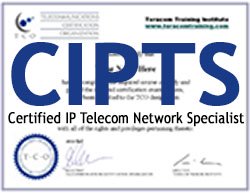
Get the knowledge needed for the new-generation MPLS-IP-Ethernet telecom network with these four courses – plus TCO Certification to prove it!
CIPTS Certification is a subset of CTNS, focusing on the new‑generation IP telecom network, its layers and its technologies, and skipping the PSTN and wireless courses.
A Certified IP Telecom Network Specialist is fully up to speed in the new-generation telecom network technologies, and how they fit together: the OSI Layers, Ethernet and MAC frames (Layer 2), IP Packets, Addressing and Routing (Layer 3) and MPLS Traffic Management.
A CIPTS understands the MPLS-IP-Ethernet structure and operation of the network. This solid knowledge base allows a CIPTS to quickly get up to speed on a particular project, then have the versatility to work on others... a good thought to have in your (potential) manager's mind.
The CIPTS Certification Package Unlimited Plan includes four CIPTS online courses and the TCO CIPTS Certification Exam, both with unlimited repeats – which means guaranteed to pass, and refresh your knowledge anytime.
The coursework for CIPTS is a set of four high-quality online multimedia courses. Click on the course name or scroll down for detailed descriptions, what you will learn, and free intro lessons:
• Protocols and standards. The OSI Model.
• Layers: Layer 2 vs. Layer 3. Examples.
• Protocol stacks. How protocol stacks work.
• LAN fundamentals. Ethernet and 802 standards.
• MAC addresses and MAC frames
• LAN switches, broadcast domains and VLANs
• Ethernet on twisted pair (Cat 5e/6 cables), radio (Wi-Fi) and fiber (Optical Ethernet)
• Packet network fundamentals. Routers.
• IP packets and IP addresses
• Static & dynamic, public & private addresses
• Network Address Translation (NAT). IPv6.
• Carrier network basics. Customer Edge (CE) device
• Service Level Agreements and CoS
• MPLS for traffic management, VPNs, integrated access
Invest in yourself with the CIPTS Certification Package!
Four CIPTS courses plus TCO Certification, giving you a solid foundation in new-generation IP-based telecom networks, datacom and networking, including the three main technologies: Ethernet, IP networking and MPLS... and how they fit together.
Get up to speed on all major topics, at your own pace. Understand the fundamentals, technologies, jargon, buzzwords and most importantly, the underlying ideas ... and how it all fits together.
Plus, get your Telecommunications Certification Organization (TCO) Certified IP Telecom Network Specialist (CIPTS) Certification to prove it!
Upgrade your skills – and your résumé – with this training and certification today!
Teracom Training Institute is a Certified Training Partner of the Telecommunications Certification Organization , authorized to administer courses and exams for TCO certifications on the myTeracom Learning Management System, and award TCO Certifications.
Certification Packages are high-quality training courses plus TCO Certification at a discounted price.
TCO Certification is proof of your knowledge of telecom, datacom and networking fundamentals, jargon, buzzwords, technologies and solutions.
It's backed up with a Certificate suitable for framing plus - a Teracom exclusive - a personalized Letter of Reference / Letter of Introduction detailing the knowledge your TCO Certification represents and inviting the recipient to contact Teracom for verification. You may list Teracom Training Institute as a reference on your résumé if desired.
The Unlimited Plan gets you unlimited repeats of courses and exams... which means guaranteed to pass if you're willing to learn, jump in and out of courses as needed and refresh your knowledge anytime.
Get started today!
Join thousands of satisfied customers including the FBI Training Academy, US Marine Corps Communications School, US Army, Navy, Air Force and Coast Guard, CISA, DISA, DoJ NSD, NSA and CIA, IRS, FAA, DND, CRA, CRTC, RCMP, banks, power companies, police forces, manufacturers, government, local and regional telcos, broadband carriers, individuals, telecom planners and administrators, finance, tax and accounting personnel and many more from hundreds of companies.
Benefit from decades of knowledge, insight and experience distilled into clear lessons designed for non‑engineers, logically organized to build one concept on another... in plain English. Teracom's GSA Contract supplying this training to the US government reflects approved quality and value that you can depend on.






The CIPTS Certification Package includes four courses that will give you the core knowledge needed for the new‑generation Ethernet‑IP‑MPLS telecom network, plus a certificate to prove it!
Course 2212 The OSI Layers and Protocol Stacks
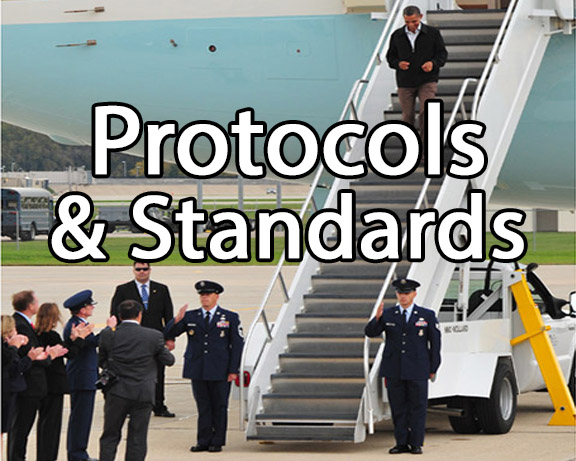
Protocols & Standards • OSI Model • Layers • Protocol Stacks • FedEx Analogy
This course begins the "IP courses" in the Certified Telecommunications Network Specialist (CTNS) certification package.
The OSI 7-Layer Reference Model is used to sort out the many functions that need to be performed, to be able to discuss separate issues separately. The functions are organized into groups called layers, which are stacked one on top of the other. This allows us to relate different pieces of the puzzle in subsequent lessons.
The course starts with the big picture, then one lesson for each layer, then protocol stacks.
Course Lessons
1. Introduction
2. Open Systems
3. Protocols and Standards
4. ISO OSI 7-Layer Reference Model
5. The Physical Layer
6. Data Link Layer
7. Network Layer
8. Transport Layer
9. Session Layer
10. Presentation Layer
11. Application Layer
12. Protocol Stacks
13. Protocol Headers
14. Standards Organizations
Based on Teracom's famous Course 101, tuned and refined over the course of more than 25 years of instructor-led training. You'll learn what a layer is, what the layers are, what each one does and examples of where things like TCP fit into the model ...and how it all works together… in plain English.
This course establishes a framework for all of the discussions in subsequent lessons and courses: the OSI 7-Layer Reference Model, which identifies and divides the functions to be performed into groups called layers.
You'll learn what a layer is, the purpose of each layer, see examples of protocols used to implement each layer, and learn how a protocol stack really works with the famous "FedEx Analogy" presented as an embedded video by our top instructor, Eric Coll.
On completion of this course, you will be able to explain:
Detailed Course Outline
1. Introduction Course introduction and overview
2. Open Systems Open systems vs. proprietary systems.
3. Protocols and Standards Illustrated overview of all the functions required for communications, and protocols vs. standards
4. ISO OSI 7-Layer Reference Model Top-level overview and introduction to Layers
5. The Physical Layer Fiber, Twisted Pair, Cable and Wireless
6. Data Link Layer LANs and MAC Addresses
7. Network Layer IP, MPLS, Packets and Routers
8. Transport Layer Reliability, Connections, Ports and Sockets
9. Session Layer SIP, POP and HTTP
10. Presentation Layer ASCII, MIME, Compression, Encryption, Codecs
11. Application Layer SMTP, HTML and English
12. Protocol Stacks How a protocol stack and peer protocols actually work. Tracing the flow through the stack with the FedEx Analogy
13. Protocol Headers Babushka Dolls
14. Standards Organizations ISO, IETF, ITU
Download the Course Brochure PDF for the full detailed description
Build structured, broad knowledge of networks - understanding that lasts a lifetime. Stand out from the crowd!
Individual Course
with unlimited repeats, Teracom Course Completion Certificate
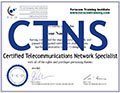
Certified Telecommunications Network Specialist (CTNS) Certification Package
Six courses including this one with unlimited repeats, TCO CTNS Certification and Letter of Reference
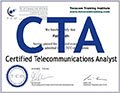
Certified Telecommunications Analyst (CTA) Certification Package
Sixteen courses including this one with unlimited repeats, TCO CTA Certification and Letter of Reference
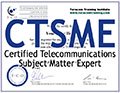
CTSME: Certified Telecommunications Subject Matter Expert certification package includes this course.
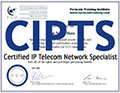
Certified IP Telecom Network Specialist (CIPTS) Certification Package
Four courses including this one with unlimited repeats, TCO CIPTS Certification and Letter of Reference
Shop with confidence!
All choices come with a 100% Money-Back Guarantee: full refund within 30 days.
Free Lesson 1: Course Introduction
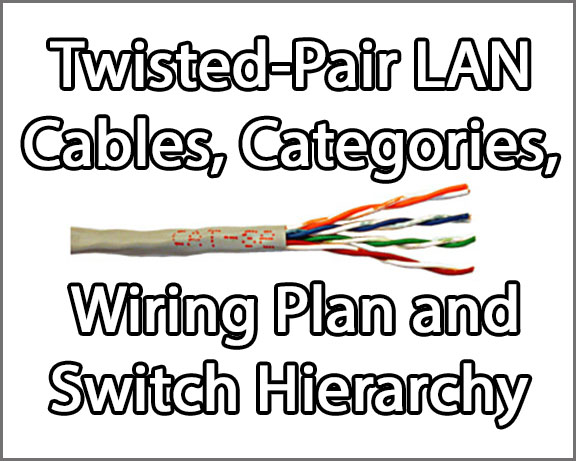
Another free lesson:
Twisted-Pair LAN Cables, Categories, Wiring Plan and Switch Hierarchy
Course 2211 LANs, VLANs, Wireless and Optical Ethernet
MAC Addresses • MAC Frames • Layer 2 Switches • VLANs • Ethernet on Copper • 1000BASE-T • Power over Ethernet • Cable Categories • Office Wiring Plan • Wireless Ethernet (Wi-Fi) • Optical Ethernet • Ethernet in the Core, MANs and PONs • Fiber Types • SFP Transceivers • Field Installation
This course is all about Ethernet: the fundamentals, equipment and implementations, including twisted-pair copper cables, wireless and optical, in‑building, in the network core, in MANs and PONs.
Course Lessons
1. Introduction
2. Broadcast Domains, MAC Addresses and MAC Frames
3. LAN Switches a.k.a. Layer 2 Switches
4. VLANs
5. 802 Physical Standards: 802.3 Twisted Pair and 802.11 Wi-Fi
6. Twisted-Pair LAN Cables, Categories, Wiring Plan and Switch Hierarchy
7. Optical Ethernet and Fiber Links 
Based on Teracom's famous Course 101, tuned and refined over the course of more than 25 years and counting of instructor-led training.
We'll cut through the jargon to demystify Ethernet, MAC addresses, LANs and VLANs, Ethernet on copper wires, Ethernet over the Ether (Wi-Fi) and Ethernet on fiber: Optical Ethernet.
You'll understand the jargon and buzzwords, the underlying ideas, and how it all works together to form the physical basis of the network that used to be called the Public Switched Telephone Network (PSTN), now being absorbed Pac-Man style by The Internet, becoming the IP Packet-Switched Telecommunications Network (IP‑PSTN).
… in plain English.
This course is all about Ethernet: the fundamentals, equipment and implementations including twisted-pair copper cables, wireless and fiber, in-building, in the network core, MANs and PONs.
Ethernet implements the equivalent of pipe physically connecting two devices. IP and MPLS are used to move packets from one pipe to another. They are covered in other courses.
Ethernet and its MAC frames has fulfilled one of the Holy Grails of telecom, packaging everything the same way on all kind of links: copper wire, fiber and wireless - in the core of the network, in the access network, and in the customer premise. Standardizing on MAC frames across the board makes interworking simpler, more reliable and cheaper to implement. One can only stand back in awe and admire.
We'll begin with the fundamental idea of a broadcast domain, first implemented with a bus cable.
We'll understand LAN interfaces, and how each interface has a hard-coded MAC addresses, and how the address field in a MAC frame is used to indicate for whom a frame is intended, since all stations in a broadcast domain receive it.
We'll then understand how the bus is now inside a box called an Ethernet switch, LAN switch or Layer 2 switch, how the switch learns the MAC address of each station, and how the LAN switch forwards MAC frames to one or more stations.
Then we'll go over the important idea of VLANs, which are broadcast domains defined in software, and how VLANs can be used to segregate traffic by device type and by work area at the enterprise level, and segregate traffic by customer at the carrier level.
You'll learn about the many standards for implementing Ethernet, 802.3 from the original 10BASE-5 to 1000BASE-T on Categories of twisted-pair cables, 802.11 wireless LANs and Wi-Fi certification.
We'll finish with a compressive lesson on Optical Ethernet: Ethernet on fiber, which is the basis of today's telecom network.
You'll learn how bits are represented on fiber, how fiber cables are installed underground, and how fiber splicing is used to connect bulk fiber to equipment.
We'll review Optical Ethernet standards from 1 Gb/s to 100 Gb/s.
Detailed Course Outline
1. Course Introduction
2. Broadcast Domains, MAC Addresses and MAC Frames
The fundamental idea of devices connected together in a broadcast domain, and how stations communicate using MAC addresses
3. LAN Switches a.k.a. Layer 2 Switches
How LAN switches are at the center of practical implementation of connecting stations, and how they forward frames between stations in a broadcast domain.
4. VLANs
Defining broadcast domains in software to segregate traffic. Used to separate customer traffic on carrier MANs, and used in-building as a basic network security measure.
5. 802 Physical Standards: 802.3 Twisted Pair and 802.11 Wi-Fi
Ethernet on copper wires, and standards like 1000BASE-T. Ethernet over the Ether, usually called Wi-Fi, and how MAC frames are communicated using radio carrier frequencies.
6. Twisted-Pair LAN Cables, Categories, Wiring Plan and Switch Hierarchy
Wiring
Ethernet to the work area with Cat 5, Cat 5e and Cat 6 twisted-pair copper-wire cables, wiring closets and Layer 2 aggregation switches.
7. Optical Ethernet and Fiber Links
The fundamental idea of representing the 1s and 0s that make up a MAC frame using light carried in a glass tube, how fibers are actually installed and commissioned, and review the Optical Ethernet implementations in the 802.3 standard.
Download the Course Brochure PDF for the full detailed description
Individual Course
with unlimited repeats, Teracom Course Completion Certificate
Certified Telecommunications Network Specialist (CTNS) Certification Package
Six courses including this one with unlimited repeats, TCO CTNS Certification and Letter of Reference
Certified Telecommunications Analyst (CTA) Certification Package
Sixteen courses including this one with unlimited repeats, TCO CTA Certification and Letter of Reference
CTSME: Certified Telecommunications Subject Matter Expert certification package includes this course.
Certified IP Telecom Network Specialist (CIPTS) Certification Package
Four courses including this one with unlimited repeats, TCO CIPTS Certification and Letter of Reference
Shop with confidence!
All choices come with a 100% Money-Back Guarantee: full refund within 30 days.
Course 2213 IP Networks, Routers and Addresses
IP Addresses • Packets • Networks • Routers • Static and Dynamic Addresses • DHCP • Public and Private Addresses • NAT • IPv6
IP Networks, Routers and Addresses is a comprehensive course on IP networking fundamentals: IP packets, IP addressing and IP routers.
We'll see how routers implement the network with packet-switching, that is, relaying packets from one circuit to another, and how routers are a point of control for network security. We'll introduce the term Customer Edge (CE), and understand the basic structure and content of a routing table.
Then we'll cover the many aspects of IP addressing: IPv4 address classes, dotted decimal, static vs. dynamic addresses, DHCP, public vs. private addresses, Network Address Translation, and finish with an overview of IPv6.
Course Lessons
1. Introduction
2. Review: Channelized Time-Division Multiplexing (TDM)
3. Statistical Time-Division Multiplexing: Bandwidth-on-Demand
4. Network: Bandwidth on Demand + Routing
5. Routers
6. IPv4 Addresses
7. DHCP
8. Public and Private IPv4 Addresses
9. Network Address Translation
10. IPv6 Overview
11. IPv6 Address Allocations and Assignment
Based on Teracom's famous Course 101, tuned and refined over the course of 20 years of instructor-led training, we'll cut through the jargon to clearly explain IP and routers, packets and addresses, the underlying ideas, and how it all works together… in plain English.
This course could also be called "Layer 3", as it is all about Layer 3 of the OSI model: the network layer, and in particular, IP packet networks.
Packet networks embody two main ideas: bandwidth on demand and packet switching.
First, we'll recap channelized TDM and its limitations, then understand statistical TDM or bandwidth on demand.
Next, we'll understand how routers implement the network with packet switching, that is, relaying packets from one circuit to another, and how routers are a point of control for network security. We'll introduce the term Customer Edge (CE), and understand the basic structure and content of a routing table.
Then we'll cover the many aspects of IP addressing – needed to be able to do the packet switching: IPv4 address classes, dotted decimal notation, static vs. dynamic addresses, DHCP, public vs. private addresses, Network Address Translation, and finish with an overview of IPv6 and IPv6 address allocation and assignment.
Detailed Course Outline
1. Introduction Course introduction and overview
2. Review: Channelized Time-Division Multiplexing (TDM) Traditional TDM – and why it is inefficient
3. Statistical Time-Division Multiplexing: Bandwidth-on-Demand Overbooking and opportunistic capacity
4. Private Network: Bandwidth on Demand + Routing The simplest framework for understanding routers and bandwidth on demand
5. Routers Routers and routing tables. Packet forwarding and packet filtering. Customer Edge.
6. IPv4 Addresses Address classes and dotted-decimal notation.
7. DHCP Dynamic addresses and static addresses – and how both are assigned using DHCP
8. Public and Private IPv4 Addresses How to obtain public addresses, and why private addresses are used in many cases
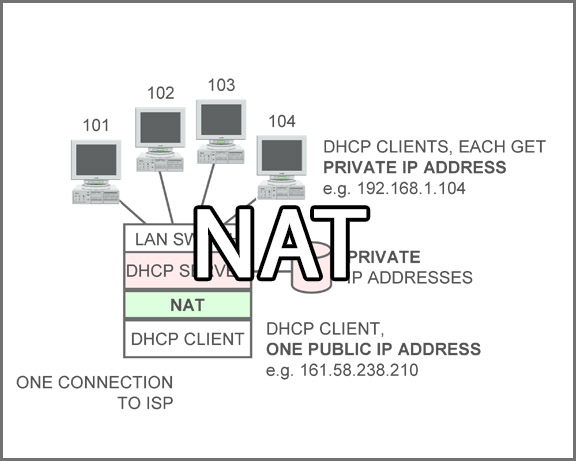
9. Network Address Translation How a NAT glues private IPv4 addressing used in-building to public addressing used on the Internet
10. IPv6 Overview Introduction to IPv6, what's new, the improvements on IPv4 and the IPv6 packet format
11. IPv6 Address Allocations and Assignment Types of IPv6 addresses, registries and allocations to ISPs. How subnets are assigned to end-users
Download the Course Brochure PDF for the full detailed description
Understand the whole IP story, including routers, packets, addresses, DHCP, NAT and IPv6. What's not to like?
Individual Course
with unlimited repeats, Teracom Course Completion Certificate
Certified Telecommunications Network Specialist (CTNS) Certification Package
Six courses including this one with unlimited repeats, TCO CTNS Certification and Letter of Reference
Certified Telecommunications Analyst (CTA) Certification Package
Sixteen courses including this one with unlimited repeats, TCO CTA Certification and Letter of Reference
CTSME: Certified Telecommunications Subject Matter Expert certification package includes this course.
Certified IP Telecom Network Specialist (CIPTS) Certification Package
Four courses including this one with unlimited repeats, TCO CIPTS Certification and Letter of Reference
Shop with confidence!
All choices come with a 100% Money-Back Guarantee: full refund within 30 days.
Course 2214 MPLS and Carrier Networks
Carrier Packet Networks • Technologies • MPLS • MPLS VPNs • SLAs • CoS • Integration & Aggregation
MPLS and Carrier Networks is a comprehensive training course designed to build a solid understanding of carrier packet networks and services, the terminology, technologies, configuration, operation and most importantly, the underlying ideas… in plain English.
We'll cut through the buzzwords and marketing to demystify carrier packet networks and services, explaining Service Level Agreements, traffic profiles, virtual circuits, QoS, Class of Service, Differentiated Services, integration, convergence and aggregation, MPLS and other network technologies, and how they relate to TCP/IP, without bogging down on details.
Course Lessons
1. Introduction
2. Carrier Packet Network Basics
3. Service Level Agreements
4. Virtual Circuits
5. QoS Requirement for Voice over IP
6. MPLS
7. TCP/IP over MPLS
8. Differentiated Classes of Service using MPLS
9. Integration and Convergence using MPLS
10. Managing Aggregates of Traffic with MPLS Label Stacking
11. MPLS Services vs. Internet Service
Based on Teracom's famous Course 101, tuned and refined over the course of over 25 years of instructor-led training, you will gain career- and productivity-enhancing knowledge of the structure, components and operation of carrier packet networks and services, how they are implemented, packaged and marketed by carriers and how they are used by government, business… and other carriers.
MPLS and Carrier Networks is a comprehensive, up-to-date course on the networks companies like AT&T build and operate, how they are implemented, the services they offer, and how customers connect to the network.
This course can be taken by those who need just an introduction to carrier networks and MPLS, as well as by those who need to build a solid base on which to build project- or environment-specific knowledge.
In the previous course, we used a private network, i.e. dedicated point-to-point circuits connected with routers, as the simplest framework for understanding packets, bandwidth on demand, routers, and network addresses.
In this course, we will take the same idea and apply it again at the carrier network level: replacing the dedicated lines with bandwidth on demand service from a carrier between the customer locations.
We'll spend much of this course understanding a powerful traffic management tool called virtual circuits, how they are implemented with MPLS, and how MPLS can be used to provide differentiated services, aggregate traffic and implement convergence.
Detailed Course Outline
1. Introduction
Course introduction and overview
2. Carrier Packet Network Basics
Customer Edge, Provider Edge, Access and Network Core
3. Service Level Agreements
Contractual specification: Traffic Profile and Class of Service
4. Virtual Circuits
Traffic Classes and pre-determined routes
5. QoS Requirement for Voice over IP
How packetized voice works and what is needed
6. MPLS
MPLS components, LER, LSP, LSR jargon, basic operation
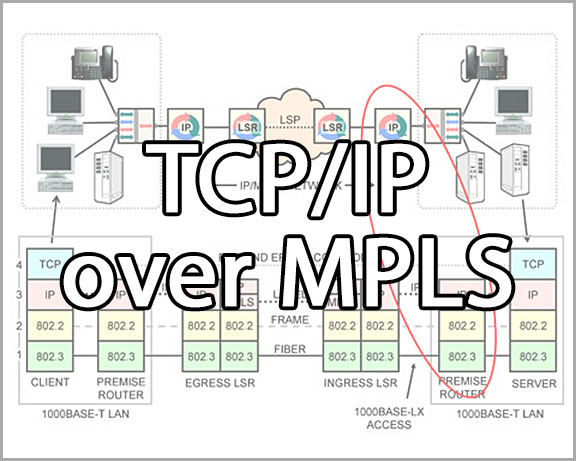
7. TCP/IP over MPLS
Tracing a file transfer through the equipment and protocols
Implementing Virtual Private LAN Service with MPLS
8. Differentiated Classes of Service using MPLS
Different transmission characteristics for different traffic
9. Integration and Convergence using MPLS
Saving money with Integrated Access: all traffic on one network technology
10. Managing Aggregates of Traffic with MPLS Label Stacking
Aggregating similar traffic to be managed as a single entity
11. MPLS Service vs. Internet Service
Understanding the key difference: guarantees or not. The Future.
Download the Course Brochure PDF for the full detailed description
Individual Course
with unlimited repeats, Teracom Course Completion Certificate
Certified Telecommunications Network Specialist (CTNS) Certification Package
Six courses including this one with unlimited repeats, TCO CTNS Certification and Letter of Reference
Certified Telecommunications Analyst (CTA) Certification Package
Sixteen courses including this one with unlimited repeats, TCO CTA Certification and Letter of Reference
CTSME: Certified Telecommunications Subject Matter Expert certification package includes this course.
Certified IP Telecom Network Specialist (CIPTS) Certification Package
Four courses including this one with unlimited repeats, TCO CIPTS Certification and Letter of Reference
Shop with confidence!
All choices come with a 100% Money-Back Guarantee: full refund within 30 days.
CIPTS Certification Study Guide and
Companion Reference Handbook
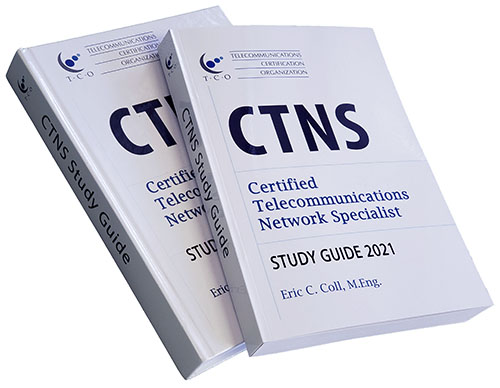
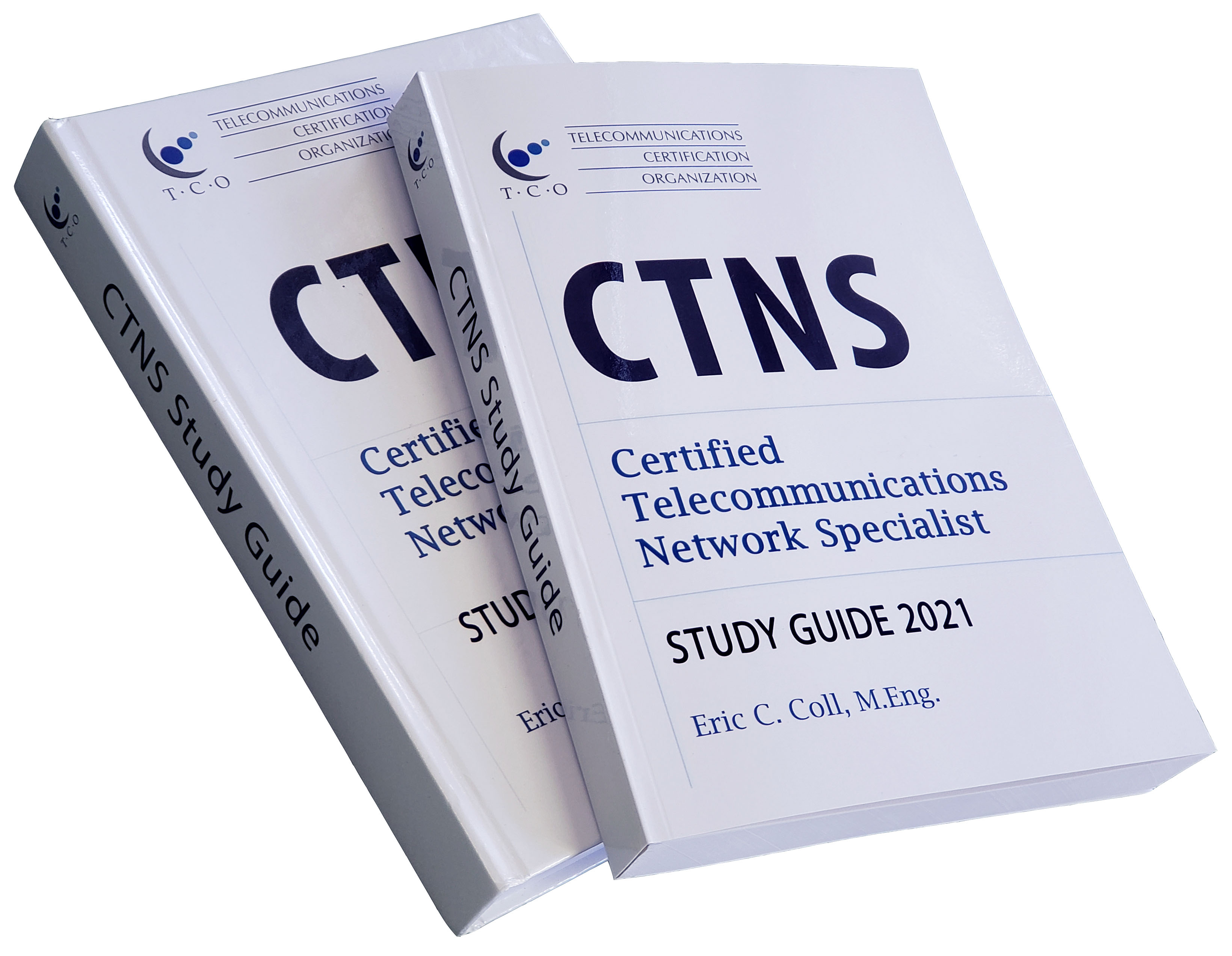
Since CIPTS is a subset of CTNS, the CTNS Study Guide also serves as the CIPTS Study Guide. CIPTS is the last four courses of CTNS:
Printed in color, the Study Guide contains all of the text and the main graphic from the online course. It is intended to enhance your learning and retention while taking the online courses. Available in a beautiful hardcover edition.
It is also useful as a day-to-day reference handbook and glossary, as the selection of material, its order, timing, and explanations are based on Teracom's famous instructor-led telecommunications training seminar Broadband, Telecom, Datacom and Networking for Non-Engineers: courses field-tested to deliver the core knowledge set needed by anyone serious in telecommunications today.
7" x 10" hardcover, softcover and eBook • 406 pages • published May 2021
ISBN 9781894887625 (softcover) ISBN 9781894887656 (hardcover) ISBN 9781894887632 (eBook)




What You Get With The CIPTS Certification Package
1. High-quality, up-to-date, comprehensive training
You will get a solid foundation of structured knowledge, delivered in our trademark "telecom for non‑engineers" style. Cut through jargon to understand the fundamentals, technologies and buzzwords… and how it all fits together, in plain English.
2. The certification exam
Each course in the certification package has an associated exam, typically ten multiple-choice questions. You get unlimited repeats of the exam - which means guaranteed to pass. Plus, on achieving a passing grade:
3. Your certificate, suitable for framing
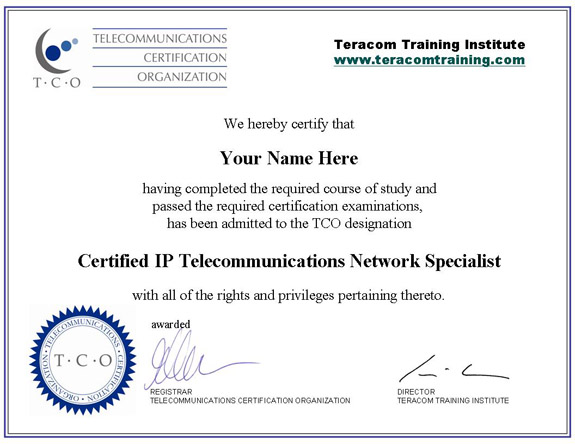
A full-color TCO Certificate suitable for framing is automatically awarded by the Learning Management System on completion of the required exams. It can be immediately printed on plain or textured paper on any color printer and framed by student as desired, with no shipping charges. It can also be attached to the electronic version of the student's CV. An original hard copy of your Certificate, signed and sealed, can be sent to you by mail for $25 plus first-class mail cost.
4. A personalized Letter of Reference / Letter of Introduction
You also receive a personalized Letter of Reference / Letter of Introduction explaining the courses you took and the knowledge you have, and inviting anyone you give it to to contact us as a reference... excellent addition to your CV.
5. Right to display the TCO logo
You'll have the right to display a high-resolution copy of the TCO logo on your résumé, business card, LinkedIn profile, web page, blog, or email signature.
6. TCO Certification Designation
Passing the Certified IP Telecom Network Specialist, you will be able to state that you:
- "are a Certified IP Telecom Network Specialist",
- "hold a Certified IP Telecom Network Specialist certification from the Telecommunications Certification Organization",
- are "certified as a Telecommunications Network Specialist by the Telecommunications Certification Organization",
- are a "Telecommunications Certification Organization (TCO) Certified IP Telecom Network Specialist",
- are "TCO-Certified",
and may sign your name - "Richard Smith, CIPTS," or "Jane Smith, Certified IP Telecom Network Specialist"
7. A 30-day no-questions-asked 100% money-back guarantee.
If for any reason you change your mind, for 30 days after purchase you can get your money back. You have nothing to lose! – and a marketable skill to gain!
Benefits of Certification For Individuals
One benefit of TCO certification is differentiating yourself from the rest of the crowd when applying for a job or angling for a promotion.
The knowledge you gain taking Teracom's Online Courses, confirmed with TCO Certification, is foundational knowledge in telecommunications, IP, networking and wireless: fundamental concepts, mainstream technologies, jargon, buzzwords, and the underlying ideas - and how it all fits together.
This type of knowledge and preparation makes you an ideal candidate to hire or promote to a task, as you will be able to build on your knowledge base to quickly get up to speed and work on a particular project - then have the versatility to work on subsequent projects.
TCO Certification will help demonstrate you have this skill... a desirable thought to have in your potential manager's mind.
Benefits of Certification For Employers
Teracom certification packages are an extremely cost-effective way of implementing consistent, comprehensive telecommunications and network technology fundamentals training, ensuring that both existing resources and new hires are up to the same speed, with a common vocabulary, framework and knowledge base.
The course exams provide concrete measurements of competency in key knowledge areas.
Management can view reports on the progress and results of team members, and export results to Excel with the click of a button. These reports identify skills strengths and deficiencies, and are a demonstration of meeting managerial objectives of team building and return on investment.
Get this training for your whole team. The scalable myTeracom Learning Management System can register and manage all of your people through courses, exams and certificates.
For larger organizations, the courses and exams can also be licensed and deployed on your LMS.
Getting Your Certificate
Each course has a course exam, consisting of ten multiple-choice questions chosen at random from a pool and shuffled in order. Passing the course exams proves your knowledge of these topics and results in your certification.
Your Certificate and Letter of Reference / Letter of Introduction will be immediately available for download from your Dashboard in the myTeracom Learning Management System. You may also order a signed and sealed Certificate by airmail.
Teracom's exclusive Unlimited Plan allows you unlimited repeats courses and exams with no expiry – which means guaranteed to get your certificate if you're willing to learn, plus jump in and out of courses and refresh your knowledge anytime in the future.
Invest in yourself
Implement a major career-enhancing upgrade to your knowledge, or prepare for a job in the telecommunications business.
Get the knowledge you need
Understand telecom, datacom and networking fundamentals, jargon, buzzwords, technologies and standard practices... and how it all fits together.
Benefit from decades of experience
with courses covering all major topics, right up to date, in clear lessons logically organized to deliver structured knowledge that lasts a lifetime.
Interactive lessons
rich with photographs, video and graphics make this self-paced learning enjoyable.
| Teracom Advantages | ||||||||||||||||
|
Technical Level and Intended Audience
Our training has been taught to wide acclaim across North America since 1992 and is designed for the non-engineering professional needing an overview and update, and for those new to the business needing to get up to speed quickly on telecommunications, data communications, IP, MPLS, wireless, networking, Voice over IP (VoIP) phone systems, SIP and security.
Our emphasis is conveying the key concept-level knowledge in plain English - which you can't get reading trade magazines or talking to vendors. We put in place a solid, valuable and long-lasting understanding. It is our goal to bust the buzzwords, demystify the jargon, and cut through the double-talk to present a clear, cohesive picture.
Based on Teracom's proven instructor-led training courses developed and refined over twenty years providing training for organizations including AT&T, Verizon, Bell Canada, Intel, Microsoft, Cisco, Qualcomm, the CIA, NSA, IRS, FAA, US Army, Navy, Marines and Air Force and hundreds of others, Teracom online courses are top-notch, top-quality and right up to date with the topics and knowledge you need.
The no-hassle training solution

Teracom's high-quality online courses are delivered in Google Chrome browser on any Windows or mac desktop or laptop, iPad, android tablet or phone with an internet connection... to any number of people, anywhere, anytime.
Ideal for self-paced training, courses are divided into lessons. Stay on a lesson for as long as you like, and move to the next lesson then write the course exam only when ready.
Team training packages with group discount and management reporting from our Learning Management System are very popular.
With the Unlimited Plan, you can repeat exams as needed, and retake courses anytime in the future. There are no time limits or expiration dates. 30-day 100% money-back guarantee.


Register for a TCO Telecommunications Certification Package
Register for Online Telecom Courses
Telecommunications Certifications